|
|
|
|
|
|
|
|
|
|
|
Learn about E-Micromobility Regulations in Maryland
Micromobility is a term for small, low-speed vehicles that are often powered by humans. E-micromobility refers to electric-powered devices, including e-bicycles and e-scooters.
Micromobility usage is quickly growing throughout Maryland, and the continued evolution of micromobility devices, including shared micromobility programs (e.g., bikeshare and scooter share), have prompted jurisdictions in Maryland to tackle new questions around mobility, policy, and equity.
E-scooter and e-bike riders, and those sharing the road, should follow the laws summarized in MDOT's newly released "Micromobility Regulation Overview" factsheet and available at lookalivemd.org/laws.
Anne Arundel County has also published a helpful fact sheet outlining the differences between e-bikes, e-scooters, and e-motos under Maryland law. Understanding these distinctions is increasingly important as e-micromobility vehicles grow in popularity and some e-motos which are not allowed on bike or multi-use trails are misleadingly marketed as "e-bikes."
View Anne Arundel County’s fact sheet differentiating these devices here.

|
|
|
|
|
|
|
Baltimore City Mayor’s Bicycle Advisory Commission Meeting Recording
 The Baltimore City Mayor’s Bicycle Advisory Commission met on January 28 at 4 p.m. The group talked through priorities for building a safer and more connected bike network, shared updates on bike projects across Baltimore, and heard questions and feedback from the public on maintenance, enforcement, traffic calming, and more. The Baltimore City Mayor’s Bicycle Advisory Commission met on January 28 at 4 p.m. The group talked through priorities for building a safer and more connected bike network, shared updates on bike projects across Baltimore, and heard questions and feedback from the public on maintenance, enforcement, traffic calming, and more.
Ms. Charlene Mingus, Active Transportation Planner at the Baltimore Metropolitan Council, presented updates on the Bikeable Baltimore Region project – a plan to create a safe and connected regional bike network.
The meeting recording is available to watch here.
|
|
|
|
|
|
|
Chesapeake Bay Crossing Public Hearings February 9, 10, and 12

The Maryland Transportation Authority (MDTA) has recommended replacing the existing Chesapeake Bay Bridge with new bridge spans near their current location. The recommendation comes out of an effort by the state to study alternatives to the 50 and 70 year old bridge spans which currently see heavy vehicle traffic and do not include any bicycle or pedestrian facilities.
The preferred alternative for the new Chesapeake Bay Crossing includes two new four-lane bridge spans with full shoulders across the Chesapeake Bay and widening of US 50/301 to eight lanes (four lanes per direction) from west of Oceanic Drive to east of Cox Creek.
This plan includes financial commitments for transit-related improvements. In addition, MDTA will continue to consider adding a bicycle and pedestrian shared-use path.
In February, MDTA and the Federal Highway Administration (FHWA) will hold virtual and in-person public hearings, providing opportunities for interested parties to review the alternatives and environmental impacts, learn about the MDTA’s Recommended Preferred Alternative, and offer testimony.
These public hearings will be held on February 9, 10, and 12. To view the times and locations of each of these meetings, visit this link.
To learn more and submit your comments, visit this link.
|
|
|
|
|
|
|
Share Your Story of Traffic Violence on Baltimore City Streets

The Vision Zero Action Plan will be a strategic document that will guide efforts in Baltimore City to reduce and ultimately eliminate fatalities and serious injuries caused by traffic crashes. Due to be completed in 2026, the plan will guide City infrastructure investments as well as communications and policy.
Whether you have been personally injured in a crash, fear for the safety of yourself and your family on certain streets, or know someone who was killed or seriously injured in a traffic incident, Baltimore City Department of Transportation (BCDOT) would like to hear what happened.
Sharing the real, human impact of crashes beyond numbers in a table is important for grounding policies and interventions. This is your opportunity to tell BCDOT about your experiences.
Your story may be used in the Vision Zero Action Plan final report or other media. If you share your story, BCDOT may follow up with you for further questions so they can highlight your experience as a call to action.
To contribute to the Vision Zero Action Plan, you can also take the Baltimore City Traffic Safety Survey, and check out the Draft High Injury Network and leave your comments.
|
|
|
|
|
|
|
BikeHoward 2026 Public Meetings and Survey

BikeHoward is Howard County’s bicycle master plan. It is the document that guides the development of the County’s bicycle network and bicycle programs.
The original BikeHoward was adopted in 2016 and has been the guiding light of bicycle infrastructure development and programming for the last decade. The County is now planning for the future with an update to the plan. To update BikeHoward, the County will conduct a thorough review of the original plan, analyze pertinent data, host stakeholder meetings, and ask for public input.
Visit the BikeHoward website to stay up to date on the plan’s development and look out for additional opportunities to provide feedback. Complete the BikeHoward 2026 survey at this link.
The County will hold four public workshops in the winter and spring of 2026:
- February 23 from 5 to 7 p.m. at Elkridge Library (6540 Washington Blvd, Elkridge, MD 21075)
- March 3 from 4:30 to 7:30 p.m. at Miller Branch Library (9421 Frederick Rd, Ellicott City, MD 21042)
- March 5 from 5 to 7 p.m. at North Laurel Community Center (9411 Whiskey Bottom Rd, Laurel, MD 20723)
- March 10 from 5 to 7 p.m. at Central Columbia Branch Library (10375 Little Patuxent Parkway, Columbia, MD 21044)
It is anticipated that there will be a draft plan ready for presentation to the Howard County Council by early summer 2026 with a target for adoption by late summer.
Use this form to sign up for occasional updates on projects and events from the Howard County Office of Transportation.
|
|
|
|
|
|
|
Maryland’s Bicycle and Pedestrian Advocacy Committee (MBPAC) 2025 Annual Report
The Maryland Bicycle and Pedestrian Advisory Committee (MBPAC) advises Maryland state government agencies on issues related to bicycling and pedestrian activity including safety, funding, public awareness, and education.
MBPAC has three focus areas for promoting bicycle and pedestrian activities:
1. Transportation – Promote non-motorized modes as healthy, efficient, and environmentally-friendly ways to travel.
2. Education and Awareness – Promote activities, programs, and policies which foster improved bicycle and pedestrian safety education across all age groups; also increase awareness of the mission and work of MBPAC.
3. Tourism & Recreation – Promoting and protecting Maryland's off-road trail system and on-road facilities, providing guidance to Maryland State agencies, and providing guidance on program strategies which promote Maryland's trails, infrastructure, and tourism resources.
To learn more, visit the MBPAC website.
Read the MBPAC 2025 annual report here.
|
|
|
|
|
|
|
The Bikeways Program 2025 Annual Report

The Maryland Department of Transportation’s (MDOT) Kim Lamphier Bikeways Network Program provides grants for the design and construction of bicycle facilities. The Bikeways Program supports projects that prioritize low-stress bicycle facilities, fill missing links in the state’s bicycle network, and enhance last-mile bicycle connections to work, school, shopping, and transit. By leveraging existing bicycle facilities and past investments, these grants complement existing state, local, and federal programs, and promote biking as a fun, healthy, and safe transportation mode.
For the Fiscal Year 2026 grant cycle, MDOT awarded 12 Bikeways Program projects totaling $1.9 million (nine design projects and three minor retrofit projects). All completed, ongoing, and recently awarded Bikeways projects are shown on MDOT’s interactive map.
Read the Bikeways 2025 annual report here.
|
|
|
|
|
|
|
Washington Street Bike Lane Achieves 95% Design Milestone
The Washington Street Bikeway & Traffic Calming project seeks to make improvements on Washington St. between Sinclair Lane and Aliceanna Street that will improve safety, expand multimodal connections, and reduce speeding.
The Baltimore City Department of Transportation has submitted 95% designs for review and are currently in the process of integrating feedback so to submit final designs for approval.
BCDOT has received a grant award of $4.1 million from the Highway Safety Improvement Program (HISP), through the Maryland’s State Highway Administration. This award covers the remaining funding gap on the anticipated construction cost.
In the fall of 2025, BCDOT worked with the offices of Councilman Jones, Councilman Glover, and Councilman Parker to door knock businesses and organizations along the corridor to share information about the project and answer questions.
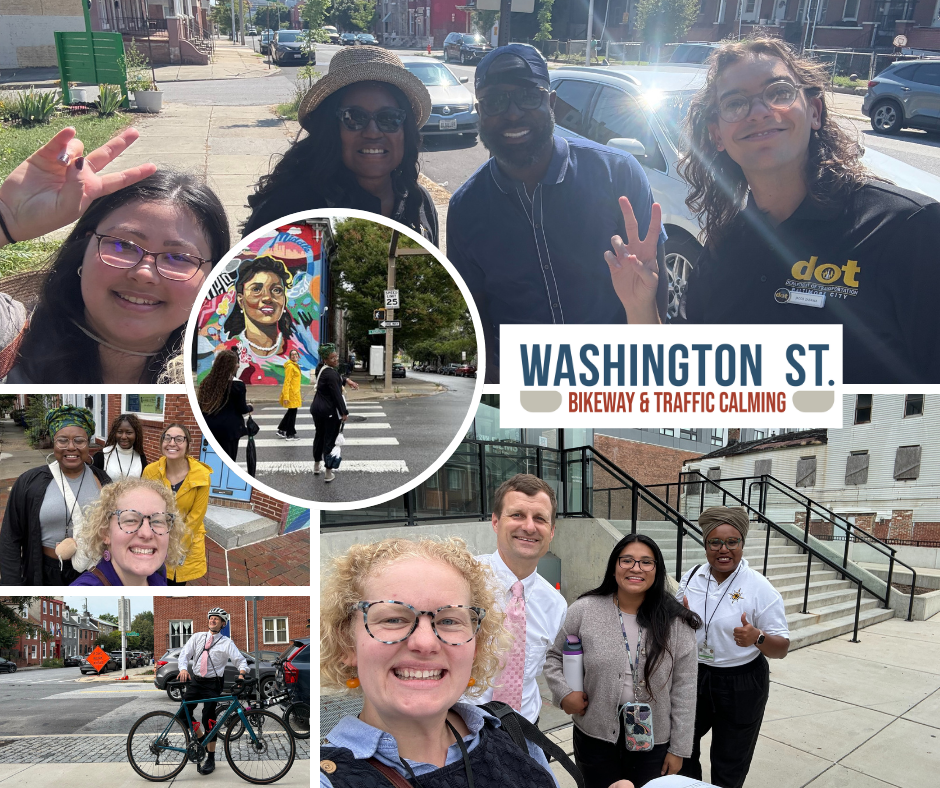
Photo: The project team and local congress-people conducting community outreach
BCDOT received the National Environmental Policy Act (NEPA) approval for this project in December 2025.
Learn more and sign up for updates at this link.
|
|
|
|
|
|
|
2050 Bicycle and Pedestrian Master Plan Tracker
In 2024, the Maryland Department of Transportation’s (MDOT) released the 2050 Bicycle and Pedestrian Master Plan (BPMP), which identified 52 recommendations to advance the department’s active transportation work. You can explore progress from the past two years on MDOT’s new dashboard here.

Photo: Screenshot of progress by BPMP goal from the dashboard
|
|
|
|
|
|
|
Central Avenue Bike Lane Extension Meeting Materials
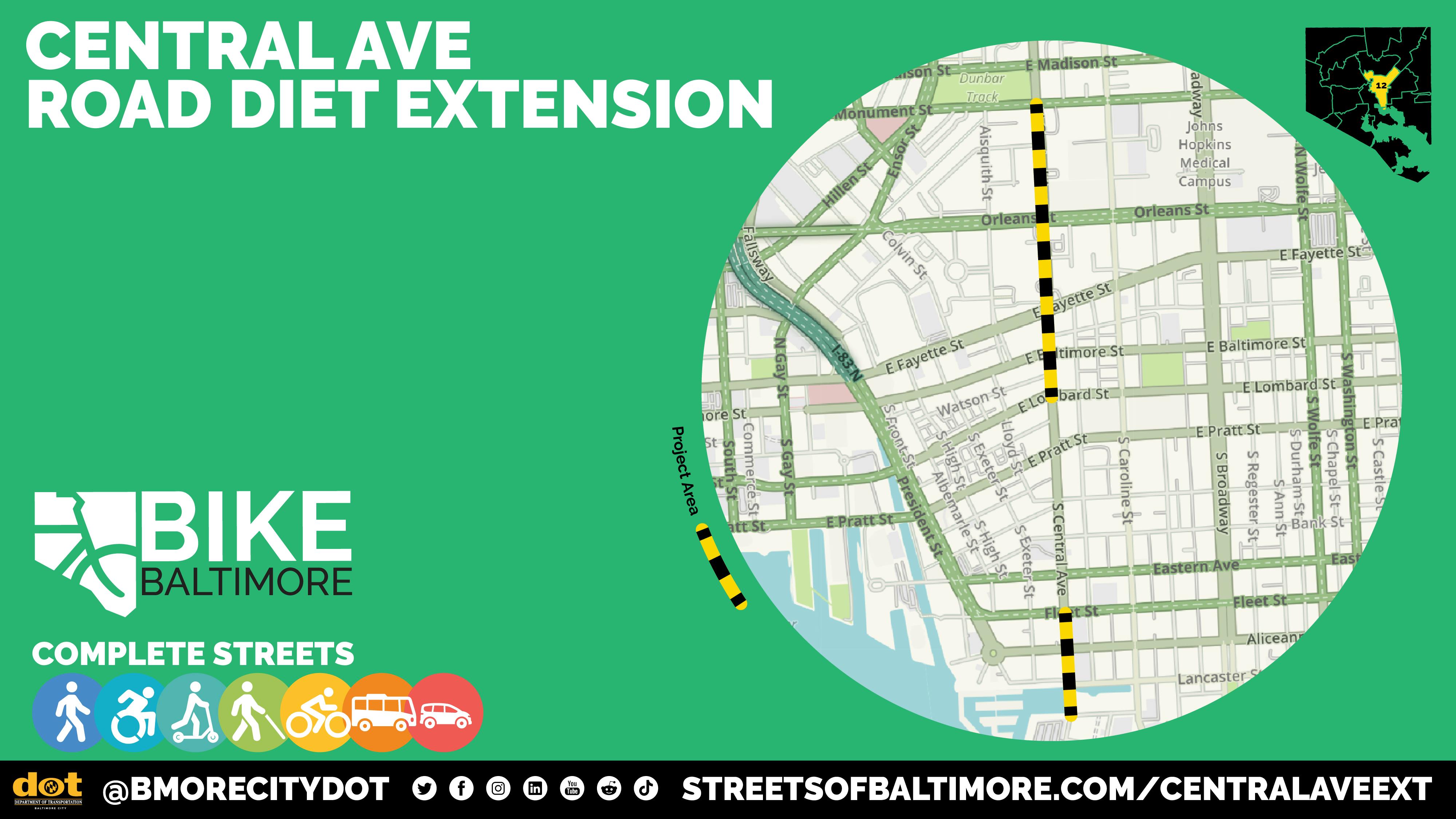
The Baltimore City Department of Transportation (BCDOT) Central Ave Road Diet Extension is designed to improve access and safety for people biking, walking, and rolling along Central Avenue. It extends the existing bicycle and pedestrian infrastructure south to the Waterfront Promenade and Harbor Point, and north to connect with the east-west cycle track along Monument Street.
These improvements help close critical gaps in the city’s bike network, connecting more residents to destinations like Harbor Point and the Monument Street cycle track.
BCDOT held a public meeting to discuss project updates on Thursday, December 11 from 6 to 7:30 p.m. at The Crossroads School (802 S Caroline Street, Baltimore, MD 21231).
If you were not able to attend the Central Avenue Bike Lane Extension community meeting, the full video is now available to watch.
Project details, maps, and a place to leave comments or subscribe for updates are available at this link.
This wraps up the scheduled community meetings for the project. Updates will be shared this spring as the design moves forward.
|
|
|
|
|
|
|
Cecil Avenue Design Update and Door-to-Door Outreach

In 2024, the Baltimore Regional Transportation Board voted to award Baltimore City 100% design funding for The Cecil Elementary Safe Routes to School Project through the Maryland Department of Transportation State Highway Administration (MDOT SHA) Transportation Alternatives Program (TAP).
The Cecil Elementary Safe Routes to School Project is a community-driven initiative aimed at enhancing the safety of students, families, and residents traveling to and from Cecil Elementary School and nearby recreational facilities. The project will include both mid-block traffic calming measures and intersection improvements at key locations
Baltimore City Department of Transportation has begun door to door outreach along Cecil Avenue between East 22nd Street and East 20th Street to talk with residents about proposed street design changes and answer questions directly.
As the design moves forward, the current concept includes:
- A new marked crosswalk at the school entrance
- Cecil Avenue becoming one way heading south between East 22nd Street and East 20th Street
- Angled parking on the east side of the street with no net loss of parking
- ADA ramps and curb bump outs at key intersections
- A raised bus stop at East 22nd Street and Kirk Avenue
Learn more and sign up for updates at this link.
|
|
|
|
|
|
|
Upcoming Meetings You Can Attend with a Focus on Active Transportation
These meetings are open to the public and welcome public comments, with some allowing the public to apply to serve as members.
Below are a sample of upcoming opportunities to listen in, learn more, and take part in active transportation decision-making in your community.
-
-
Next Meeting: Tuesday, February 10 from 11 a.m. to 1 p.m.
-
What they do: Advise the County Executive, County Council and County Departments on the implementation of the County's Pedestrian/Bicycle Master Plan.
-
-
Next Meeting: Tuesday, February 10 from 3 to 5 p.m.
-
What they do: Advise the County Executive and County Administration on matters of bicycle transportation, particularly the implementation of the Bicycle Master Plan.
-
-
Next Meeting: Wednesday, February 11 at 2 p.m.
-
What they do: Bring together voices across all modes of travel; walking, rolling, biking, transit, and driving; to help guide how the City designs safer, more accessible streets for everyone.
-
-
Next Meeting: Wednesday, February 11 from 6:30 to 8:30 p.m.
-
What they do: Advise the County Executive and Council on transportation planning and policy.
-
-
Next Meeting: Tuesday, February 24 from 9 to 11 a.m.
-
What they do: The BRTB sets priorities for major transportation investments — like roads, transit, bike, and pedestrian projects—across multiple jurisdictions, helping decide how federal transportation dollars are spent in the region.
-
-
Next Meeting: Wednesday, February 24 at 6 p.m.
-
What they do: Advise the County Executive and County Council on transportation policies, priorities, and projects.
-
-
Next Meeting: Wednesday, March 18 from 1 to 3 p.m.
-
What they do: Advise the Baltimore Regional Transportation Board (BRTB) on regional bicycle and pedestrian planning; provide technical assistance to the BRTB and members; and promote safe biking and walking in the region.
|
|
|
|
|
|
|
|
|
|
|
|
|
|