Skagit County Agritourism Study and Survey
Skagit County Agritourism Study and Survey
 Agritourism is a commercial enterprise at a working farm or ranch meant for the enjoyment of visitors that often generates supplemental income for the owner. Agritourism activities could involve education, entertainment, direct sales, outdoor activities, or hospitality.
Agritourism is a commercial enterprise at a working farm or ranch meant for the enjoyment of visitors that often generates supplemental income for the owner. Agritourism activities could involve education, entertainment, direct sales, outdoor activities, or hospitality.
Currently, Skagit County has nearly 85,000 acres of cropland or pastureland producing grass/hay, potatoes, shellfish, field corn, barley, blueberries, spinach seeds, green beans, wheat, flowers, and other crops. Dairies along with potatoes and floriculture are top value products. There are dozens of existing agritourism operations including u-pick fields, farm tours, corn mazes/hayrides, events, rentals, farm stays, classes, tasting rooms, weddings, and others.
Since 2021, Skagit County has been exploring and analyzing what agritourism means to the County’s agricultural community, rural residents, and others. The evaluation considers the current code allowances for farm stands, u-pick, tours, and options for other types of agritourism, such as potentially food service allowed on farms, wedding venues, temporary event spaces, etc.
There is a strong sense of the need to preserve farmland, and Skagit County has a long history prior to the Growth Management Act (GMA )of protecting farmland. Through a zoning modification in 1979, the County established a 40-acre lot size for lands zoned Agricultural – Natural Resources Lands (Ag- NRL). This minimum lot size ensures that property is not divided into farmland parcels that are too small to be productive. Combined within strong restrictions on non-agriculture uses of farmland, this zoning code helps maintain almost 70,000 acres of the roughly 89,000 acres of Skagit farmland that supports an annual industry worth several-hundred-million dollars. Go to www.skagitcounty.net/SkagitAGT for more information on the history of zoning for Skagit County Agriculture.
The purpose of this questionnaire is to have a dialogue, with many different community stakeholders, on how or whether to allow for tourism on Agriculture lands so as not diminish their productivity or cause a net-loss of farmland. Go to www.skagitcounty.net/SkagitAGT for more information on how much farmland could be lost if development patterns occur at a similar pattern and rate as in the past.
Based on research and community engagement, a legislative proposal will be developed for consideration by the Skagit County Planning Commission and Board of County Commissioners. This could include potential amendments to the Comprehensive Plan, zoning map, or development regulations that fit the Comprehensive Plan vision and the Growth Management Act resource land protections.
Over 2021 through spring 2022, the County published a situation assessment, draft policy options, and survey (2021, 2022) and meeting (2021, 2022) summaries. See the project website: www.skagitcounty.net/SkagitAGT.
In Fall 2022, Skagit County advertised the survey in the media and mailed nearly 17,000 postcards to rural and agricultural property owners and is inviting maximum input to this online survey. A paper copy of the survey is available to pick up at Skagit County Planning and Development Services. If you are short on time, or don’t like open-ended questions, you can skip those. Please take 15 minutes to share your ideas. Thank you!
About You
Do you live or work in Skagit County? (Choose one)
Please share where you live in Skagit County using the zip codes provided below.
Do you own or lease farmland in Skagit County?
Agritourism Goals
The County has developed some goals for the agritourism policy options to guide how policies and code could be updated.
One main goal of Agritourism has been that any Agritourism activity should be an accessory use to the main agricultural use. The purpose of this goal is to ensure no loss of productive farmland at the expense of agritourism. Do you agree with this goal?
In your opinion, how can the county preserve farmland while allowing for agritourism? (Please select one response that best represents your opinion)
Agritourism Options
State laws and County comprehensive plan policies support agricultural lands protection, limited accessory agricultural uses, and protection of rural character. Agritourism uses may be allowed if they are compatible with the onsite agricultural use (size, scale, intensity) and if located in an already developed area or if less than 1 acre in size. Please share your thoughts on allowing the following activities in agricultural or rural residential areas.
Wedding Facilities
Currently, the County does not permit wedding facilities in agricultural lands. Some counties allow wedding activities in existing barns or as temporary uses limiting size and frequency. Weddings may attract around 250 guests on average per event. Depending on if is a temporary or year-round activity there could be 6,000-13,000 visitors per year.
Weddings should not be permitted under any kind of permit in the Ag-NRL zone.
Please explain your answer above.
Weddings should be allowed if permitted as a special event and limited in number of events and size of events, and proper infrastructure to support a wedding is onsite.
Please explain your answer above.
Tasting Rooms or Restaurants
In Skagit County, currently, restaurants and wineries, breweries, or tasting rooms are allowed in several urban zones, rural commercial zones, or rural industrial zones, but not in agricultural resource zones or rural residential zones.
In Washington State, the typical size for tasting rooms varies from less than 100 square feet to over 2,000 square feet. Visitors could range up to 12,000 annually. Restaurants that offer seating are typically smaller than 5,000 square feet. Their number of visitors could be similar to that or greater.
Skagit County should continue its current policies and codes that do not allow tasting rooms or restaurants on land zoned for agricultural or rural residential purposes.
Please explain your answer above.
Allow an accessory tasting room if it is subject to a special use permit, which would allow for temporary events, noticed to nearby property owners, and other permit requirements are met to ensure safety and proper infrastructure. Periodic renewal of the permit would be required and a report to verify compliance.
Please explain your answer above.
Allow accessory tasting rooms if the tasting room is sized in proportion to the acres of on-site grapes/hops/fruit grown (e.g. small room if 10 acres grown onsite, or moderate size room if at least 20-40 acres grown). Please choose two options below.
Please explain your answers above.
Allow limited food service only to an already allowed accessory farm stand or farm-based business as a take-out only use. An example would be a drive thru coffee (or other food or beverage) stand with no seating.
Please explain your answer above.
Allow food service if the accessory restaurant is subject to a special use permit, which means that food service would be temporary and limited to special events. All permit requirements for proper infrastructure and notice would be included.
Please explain your answer above.
Allow restaurants or tasting rooms as a primary use if the subject property is rezoned to a commercial zone, on a case by case basis, after a public hearing and noticed to property owners.
Please explain your answer above.
Changing Existing Agritourism Allowances
Farm Stands, U-Pick
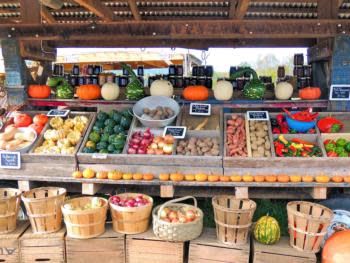
Skagit County allows farm stands called “seasonal roadside stands” in most rural and resource zones and sized to be between 300 and 5,000 square feet. They may have up to 500 visitors a year by themselves.
U-pick and farm tours are allowed as accessory uses to farm in most rural and resource zones. Studies have shown that over half of customers of farm stands are local. U-pick operations could support about 400-2,000 customers per year. Farm tours could attract up to 2,000 visitors per year depending on seasonal use.
The County is considering how to improve the review and permitting of these uses.
Please explain your answer above.
Make no changes to the code in regards to farm stands and u-pick. These are allowed in most rural resource zones.
Simplify the current permit process for farm stands and u-pick to make it easier, but do not change the regulations.
Please explain your answer above.
Update the design standards for u-pick and farmstands by either (a) only allowing for it to be developed in an area that has the needed parking and infrastructure (to ensure no loss of farmland) or (b) allow development of infrastructure if it has minimal impact on the environment - environmentally and on loss of farmland.
Please explain your answers above.
Farm Stays
Skagit County allows bed and breakfast operations with administrative special use permits. Similar uses include farm stays, which are accommodations on a working farm. A type of overnight stay that is not addressed in the Skagit County Code is a temporary farm stay with a recreation vehicle (RV) popularized by Harvest Hosts.
Continue to allow bed and breakfasts as a permanent accessory hospitality activity, subordinate to the farm use.
Please explain your answer above.
Allow temporary farm stays. This includes RV or other camping or temporary stays.
Please explain your answer above.
Allow temporary farm stays if there are limited days of visits (e.g. max stay of 30 days) or there are limited number of RVs (no more than 1-2 vehicles) or they are operated to be low impact (no development of new infrastructure is needed to support them).
Please explain your answer above.
Seasonal Events – Festivals, Farm to Table, Farm Tours
Seasonal festivals may celebrate harvest and other agricultural activities. In Skagit County, the festival of farms has attracted 20,000 attendees and the Tulip Festival 300,000.
Skagit County allows festivals and events with administrative special use permits, and special temporary use standards. Temporary events must have parking fully contained onsite, and not use of any road right-of-way. This could be a concern for damage to agricultural soils; a shuttle service to the event could be used.
A Farm to Table event is a smaller and can average 130-200 people per event. Some smaller events could potentially be permitted as an accessory use with a programmatic permit.
Continue the current temporary activity regulations that allow some festivals and events but a limited number of events.
Please explain your answer above.
Reduce the number of special events permitted no less than what the code currently permits. Also reduce the size of events to smaller than what is permitted. Please select two options below.
Please explain your answers above.
Allow smaller temporary activities like farm-to-table events permitted as an accessory activity with a programmatic permit which limits size and number of events.
Please explain your answer above.
Do not allow any farm to table events.
Please explain your answer above.
Permit Process and Criteria Improvements
Clear application and review procedures, combined with amended definitions and standards, should assist with code enforcement efforts. As well, ensuring adequate staff resources for code enforcement will be necessary. To ensure that the permitting process is fair and effective Skagit County could adjust its procedures. Improved permit procedures, criteria, and enforcement could apply to any or all of the agritourism uses under review.