Skip Navigation

Virginia 2026 Roadway Safety Survey Questionnaire

Virginia 2026 Roadway Safety Survey Questionnaire

Virginia is updating its Strategic Highway Safety Plan (SHSP) – Arrive Alive. This plan sets the statewide direction for making Virginia’s roads safer for everyone—drivers and passengers, pedestrians, bicyclists, motorcyclists, and others.


The Steering Committee, which consists of the Virginia Department of Transportation (VDOT), Virginia State Police (VSP), Department of Motor Vehicles (DMV), Department of Health (VDH), and other state and local agencies and safety partners overseeing this effort, wants to hear from you. Please share your experiences and concerns about roadway safety. Your feedback will help shape the next SHSP and guide safety efforts in the coming years.


Taking this survey is completely optional. The survey contains 19 questions and will take approximately five minutes to complete. You do not need to answer every question before clicking "Submit Survey" at the end of the survey. Your responses are anonymous and confidential, and we will only report results as combined totals across the state.
 

Section 1

Section 1: Top Safety Concerns for Each Emphasis Area

The current SHSP focuses on 13 emphasis areas (EA), which are predominant factors that contribute to or result in fatalities or serious injuries. The EAs are organized by the five (5) elements from the Safe System Approach (Safe Road Users, Safe Vehicles, Safe Speeds, Safe Roads, and Post-Crash Care).
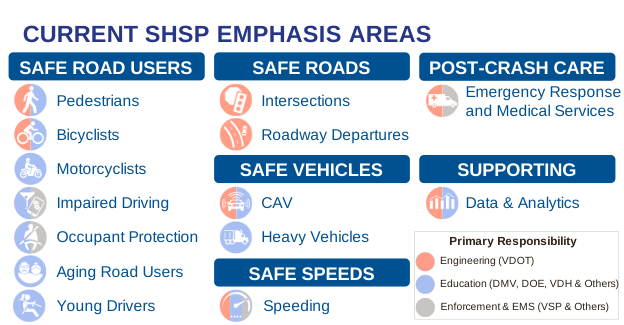
This section aims to understand which safety issues within each emphasis area are most concerning to the public. Each question focuses on one emphasis area. Questions are listed in order of the five elements from the Safe System Approach.  

Safe Road Users

When it comes to the safety of Pedestrians & Bicyclists, what concerns you the most?

No concerns
Lack of visibility/lighting
Lack of safety infrastructure (no sidewalks, no bike lanes)
Worn/damaged safety infrastructure (cracked sidewalks, obstructed bike lanes)
Lack of safety features at intersections (no crosswalks, curb extensions, curb ramps, improper signal timing)
Speeding (drivers involved in pedestrian and/or bicyclist crashes are driving above the posted speed limit)
Land use context (low density development forces pedestrians and/or bicyclists to use roads that are designed for cars, not people)
Impaired driving (drivers who are either drunk, distracted, drugged, or drowsy)
Impaired pedestrian or bicyclist (pedestrians and/or bicyclists who are either drunk, distracted, drugged, or drowsy)
Other
Closed to responses

When it comes to the safety of Young Drivers (between 15 and 20 years old), what concerns you the most?

No concerns
Lack of driving experience/knowledge
Lack of education materials for legal guardians/parents of young drivers
Young people driving above the posted speed limit
Impaired driving (young drivers who are either drunk, distracted, drugged, or drowsy)
Young driver actions or responses with left turns, right turns, or running red lights
Occupant protection (young drivers who are not using seatbelts properly)
Other
Closed to responses

When it comes to the safety of Aging Road Users (65+ years old), what concerns you the most?

No concerns
Effects of aging (vision, reaction time, flexibility, judgment)
Lack of educational materials for and/or engagement with aging road users
Vehicle technology advancements challenging aging road users
Roadway technology advancements challenging aging road users
Driving too slow for driving conditions (way below the speed limit)
Impaired driving (aging road users who are either drunk, distracted, drugged, or drowsy)
Aging road users' actions or responses navigating busy roadways or intersections (left turns, right turns, or running red lights)
Other
Closed to responses

When it comes to Occupant Protection (using seat belts and child safety seats), what concerns you the most?

No concerns
Neglectful or improper use of occupant protection devices (not wearing seatbelt, not using the appropriate child safety device)
Lack of education and awareness about seatbelts and/or properly using child safety devices
Ineffective laws for requiring occupant protection devices
Other
Closed to responses

When it comes to Impaired Driving, what type of driver impairment concerns you the most?

No concerns
Drivers who are drowsy
Distracted drivers
Drivers under the influence of drugs
Drivers under the influence of alcohol
Other
Closed to responses

When it comes to Impaired Driving, what concerns you the most?

No concerns
Limited efforts to educate road users about impaired driving
Speeding (impaired drivers driving above the posted speed limit)
Occupant protection (impaired drivers who are not using seatbelts properly)
Impaired drivers' perception-reaction time
Impaired drivers' understanding and obedience of roadway rules
Other
Closed to responses

When it comes to the safety of Motorcyclists, what concerns you the most?

No concerns
Ability to see motorcyclists coming
Motorcyclists not wearing helmets
Motorcyclists riding above the posted speed limit
Motorcyclists who unintentionally leave the road
Motorcyclists who are either drunk, distracted, drugged, or drowsy
Motorcyclists involved in crashes at intersections, like left turns, right turns, or running a red light
Other
Closed to responses

Safe Vehicles

When it comes to Heavy Vehicles (e.g., buses, semi-trailers, single-unit trucks with two or three axles), what concerns you the most?

No concerns
Limited efforts to educate drivers of heavy vehicles about safe driving practices
Limited efforts to educate other drivers about safe driving practices near heavy vehicles
Limited efforts to enforce Commercial Motor Vehicle (CMV) regulations (laws regarding the work hours/driving times of CMV drivers to reduce the incidence of drowsy driving)
Speeding (heavy vehicles driving above the posted speed limit)
Other
Closed to responses

When it comes to the safety of Connected & Automated Vehicles (CAV), what concerns you the most?

No concerns
Cybersecurity risks/data privacy (potential cyberattacks can interfere with the CAV safety operation and/or data privacy for the rider)
Technology failure and system reliability (system malfunctions of the CAV supporting technology, such as sensors, cameras, lidar, software)
Driver overreliance (drivers becoming complacent, distracted, or forgetting how to drive)
Multi-modal environment (situations with multiple transportation modes—pedestrians, bicyclists, etc.—present various safety challenges for CAVs)
Emergency decision-making
Other
Closed to responses

Safe Speeds

When it comes to Speeding, what concerns you the most?

No concerns
Limited efforts to educate road users about the dangers of speeding
Many or most drivers driving above the speed limit around me
One or a few driver(s) driving at extremely high speeds, making it more dangerous for me
Speeding drivers unintentionally leaving the road
Speeding drivers who are either drunk, distracted, drugged, or drowsy
Speeding drivers crashing at intersections, left turns, right turns, or running a red light
Other
Closed to responses

Safe Roads

Where do you feel most at risk for a Roadway Departure (where the vehicle unintentionally leaves the travel lane)?

No concerns
On narrow two-lane roadways
On roadways with no shoulder
On tight curves
On wet, snowy, or icy pavement
Other
Closed to responses

When it comes to safety at Intersections, what concerns you the most?

No concerns
Lack of visibility for motorists
Lack of visibility for pedestrians/bicyclists
Drivers running red lights
Drivers turning right on red
Drivers making left turns at signalized intersections
Drivers making left turns at unsignalized intersections
Limited efforts to educate road users about the dangers of intersections
Other
Closed to responses

Post-Crash Care

When it comes to Emergency Response & Medical Services for traffic crashes, what should be prioritized?

Arrival and on-scene time (the amount of time before EMS arrives at the crash and the amount of time spent at the crash site before the victim is transported for care)
Patient destination (the amount of time in transport from the crash site to the hospital and whether the patient was taken to the appropriate hospital based on the level of trauma)
Patient outcome (whether the patient survived the amount of post-crash care or disability)
Roadway clearance to avoid secondary crash
Other
Closed to responses