
Dictionary · Planning and land use
What is Rezoning Engagement?
Rezoning engagement is how a local government informs and hears from the community on a rezoning case. It is citizen engagement applied to one parcel and one decision: the neighborhood meeting before the application is filed, the notice and outreach while the case is reviewed, the comments collected before each hearing, and the report back after the council or board votes.
Rezoning changes the zoning district a property sits in, so that different uses, heights or densities are allowed there. The council or board adopts it as an ordinance after public notice and a hearing.
More terms in the PublicInput dictionary.
Why rezoning engagement matters
A rezoning runs on a legal clock. Notice goes out a set number of days before each hearing, the window to respond is short, and the people who hear about it are mostly owners inside the notice radius. Renters, people a few blocks away and anyone who does not come to an evening hearing are easy to miss.
The result is a record that shows who was able to show up, not what the neighborhood thinks. Rezoning engagement fixes that by starting earlier, reaching wider and closing the loop.
How to drive engagement on rezoning projects
Ten steps, in the order a case moves through review.
Before the application is filed
1. Hold a neighborhood meeting while the proposal can still change
Many cities require or encourage the applicant to meet neighbors before filing. Treat it as a real conversation: share the site plan, say what district is being asked for and why, and write down every concern. A change made here costs far less than one made after a contested hearing.
2. Map who should hear about it
Start with the notice radius, then add who lives, works and travels there: renters, businesses, schools, and the community-based organizations residents already trust. Note which languages are spoken in the area.
When the case is filed
3. Give every case its own page in plain language
One page per case, linked from the notice and the site sign, with:
- What would change, in a sentence, beside the current and proposed district
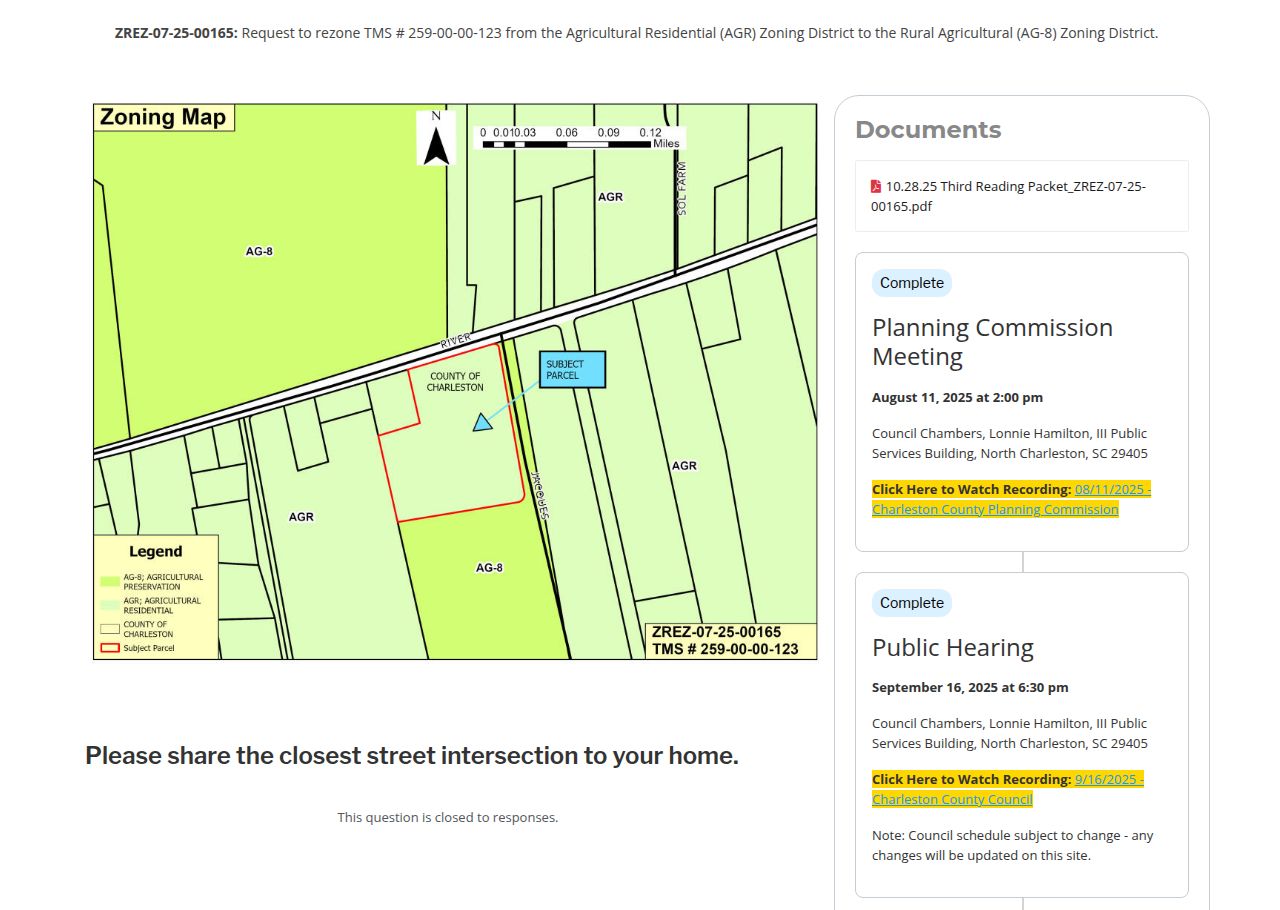
- A map of the site and the notice area
- Every date: neighborhood meeting, commission hearing, council hearing
- The application, the staff report and the conditions, when they exist
4. Reach past the mailed notice
The mailed letter is the legal floor. Add email and text updates people can subscribe to by case, by topic or by area, a site sign with a short link and a QR code, social posts, and flyers shared through local organizations. Each channel should point to the same case page. Charleston County lets residents subscribe by geography, such as Johns Island, or by topic, such as historic preservation.
5. Make commenting take a minute, not an evening
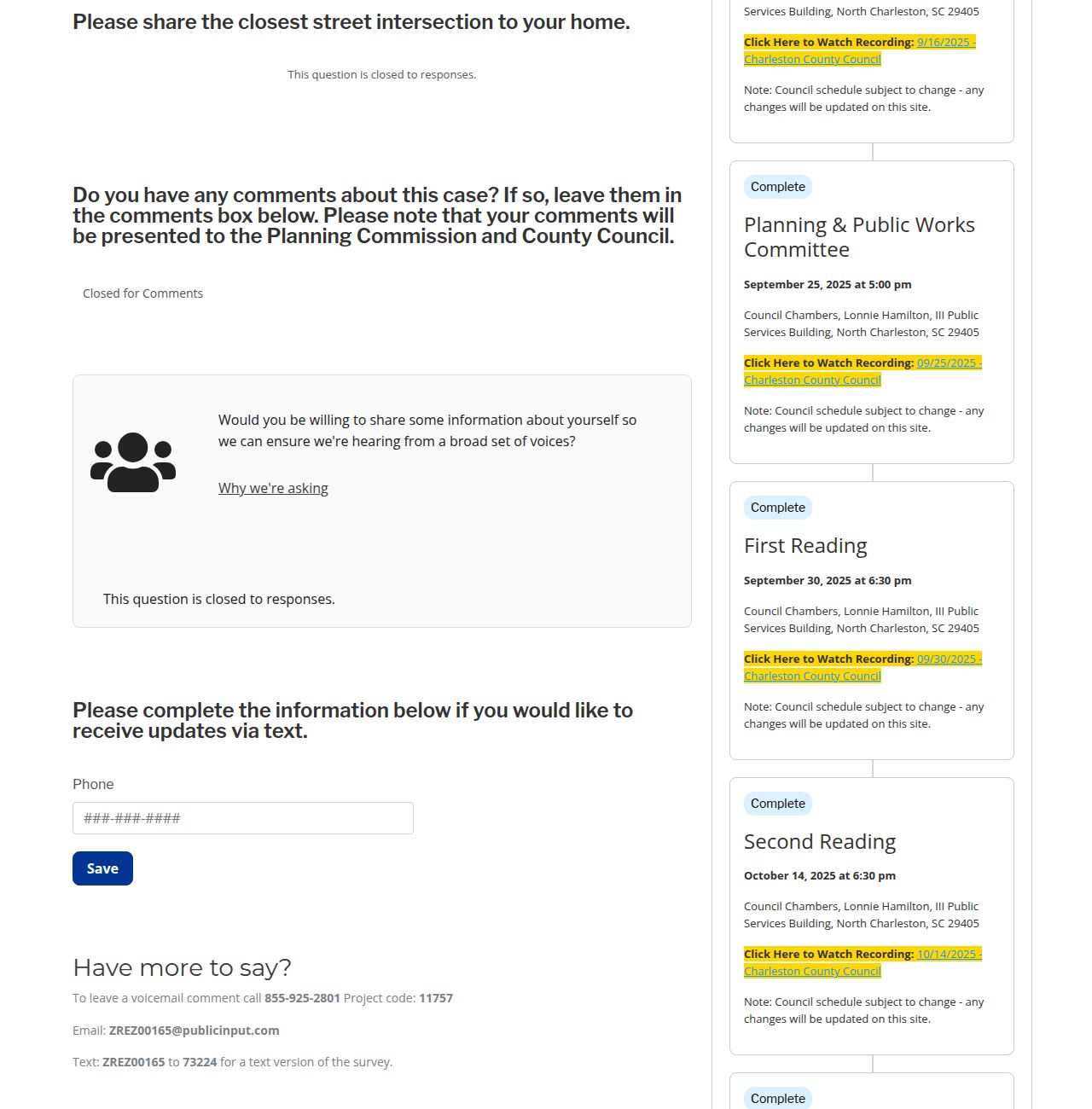
Let people comment online at any time, by email, by text, by voicemail or on a map pin, in the languages spoken in the area. Charleston County gives each case its own email address and a project code residents can text, so someone who cannot come to an evening hearing, or would rather not speak in public, still has a quick way in. Ask one or two focused questions, and say how comments will be used.
Before the hearing
6. Turn every commenter into a subscriber
Add everyone who comments to the case’s update list, so they hear about the next hearing, the staff recommendation and the vote without having to check back. Each case then grows the list of engaged residents for the next one.
7. Show residents what was decided before
People trust a process they can check. Link the case page to past rezonings nearby, the adopted plan for the area, and the staff report, so residents can see how similar requests went and why.
After the decision
8. Keep every comment in one record, and put it in the packet
Forward emails into the case, log calls and voicemails, and add what was said in person, so every channel lands in one project record. Then summarize comments by theme and by where participants live, including whether they live in the area at all, and attach the summary to the staff report so the planning commission and the council read it before they vote. It replaces the printed binder that has to be rebuilt every time a new letter arrives.
9. Close the loop
Tell everyone who took part what was decided and what their input changed, such as a condition added or a height reduced. People who see their comments used come back for the next case.
10. Measure who is missing
Compare who took part with who lives in the area. If renters or a language group are underrepresented, change the outreach on the next case. Tracking this across cases turns engagement from a checkbox into civic participation the community can see.
Case study
How Charleston County, SC runs rezoning engagement
South Carolina law requires Charleston County to ask for public input on rezonings and comprehensive plan changes, special exceptions and variances, and historic preservation cases. Those cases go before four bodies: County Council, the Planning Commission, the Board of Zoning Appeals and the Historic Preservation Commission.
Before
Comments arrived as emails, paper letters, petitions, voicemails and one-off surveys. Staff sorted hundreds of them by hand, and preparing for the nine-member council meant printing large binders and reprinting them as new feedback came in. It was hard to report on, and hard to tell who was being heard.
After
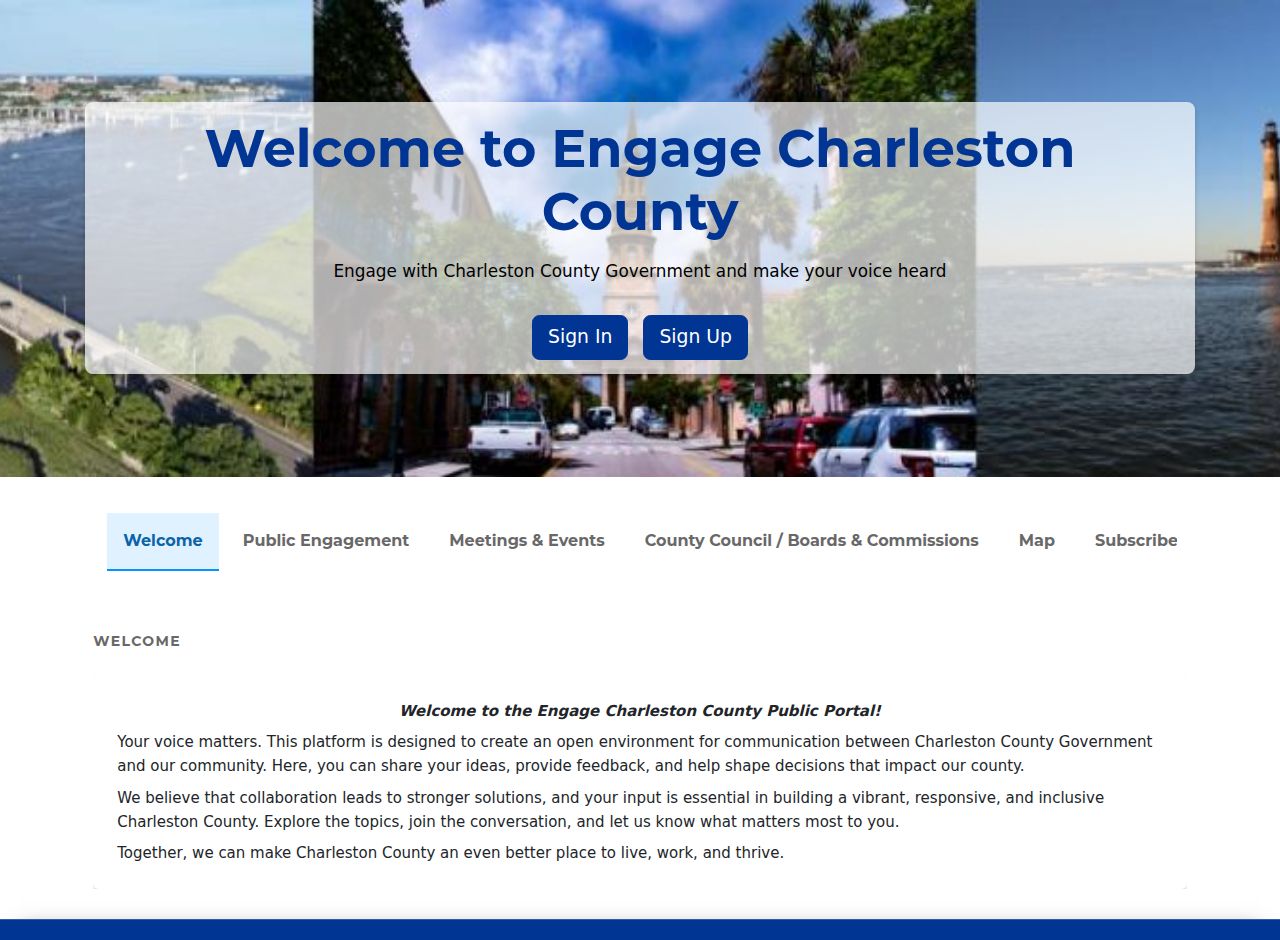
Every case now has a page on Engage Charleston County, with a description, a map, each meeting from Planning Commission to Council readings, and the latest documents. Residents comment online, by email, by text or by voicemail, and every channel lands in one project record staff can tag, filter and report on for each board.
- Share of comments in support
- 1 to 2% rose to 16%
- Growth in positive feedback
- About 8x
- Recognition
- PublicInput Resourceful Innovator Award
Figures from Charleston County’s Zoning & Planning Department, as published in How Charleston County freed up staff time while growing positive feedback 8x.
Webinar
Rezoning in Action: Community Engagement That Builds Trust and Transparency
Niki Grimball of Charleston County Zoning & Planning and PublicInput CEO Jay Dawkins walk through the resident experience, the staff workflow and what a system of record changes for land use planning.
Questions planners ask
What is rezoning engagement?
Rezoning engagement is how a local government informs and hears from the community on a rezoning case. It covers the neighborhood meeting before filing, the notice and outreach while the case is reviewed, the comments collected before each hearing, and the report back after the vote.
What is rezoning?
Rezoning changes the zoning district a property sits in, so that different uses, heights or densities are allowed there. The governing body adopts it as an ordinance after public notice and a hearing.
How did Charleston County increase engagement on rezoning cases?
Charleston County gave every rezoning case its own page and let residents comment online, by email, by text and by voicemail, with every channel landing in one project record. The share of comments in support rose from 1 to 2% to 16%, about 8x.
Isn’t the mailed notice enough?
A mailed notice to nearby property owners is usually the legal minimum. It misses renters, people who live just outside the notice radius, and anyone who does not read the letter in time. Add a project page, email and text updates, on-site signs with a link, and outreach through community organizations.
When should engagement on a rezoning start?
Before the application is filed. A neighborhood meeting ahead of filing lets the applicant hear concerns while the proposal can still change, and many cities require or encourage one.
How do you show decision makers what the public said?
Summarize the comments by theme and by where participants live, attach the summary to the staff report, and include it in the packet for the planning commission and the council.
See it on one of your rezoning cases
Tell us a little about your community. We will set up a walkthrough using a rezoning case like yours, and show you the case page, the comment channels and the engagement summary.
Run every rezoning case from one place
PublicInput gives each case its own page with comments, maps and surveys, reaches residents by email, text and phone in their language, and keeps every comment in one record, ready for the engagement summary.
See engagement solutions