
ADA Coordinators Guide: Managing Accessibility Risk Across Public Engagement

For ADA Coordinators, accessibility is not a single deliverable. It is an ongoing responsibility that cuts across departments, tools, and communication channels.
While public meetings are often the most visible part of compliance, they are only one piece of a much larger system. Today, accessibility expectations extend across the full public engagement lifecycle, including surveys, websites, documents, recordings, and feedback tools.
The challenge is not awareness of requirements. It is maintaining consistency across an environment where content is constantly changing and rarely created in one place.
This guide focuses on what ADA Coordinators are actually responsible for: oversight, risk reduction, and ensuring accessibility standards are consistently met across the systems that support public engagement.
The real challenge: accessibility breaks down at the system level
Most accessibility issues do not come from a single mistake. They come from variation. In practice, public engagement content is:
- Created by multiple departments
- Published across different platforms
- Updated frequently without centralized control
- Stored in a mix of formats and systems
This creates a predictable pattern: even when teams understand accessibility requirements, consistency is difficult to maintain. For ADA Coordinators, the core challenge is not compliance knowledge. It is operational consistency.
Where accessibility risk actually shows up
Accessibility gaps tend to cluster in the same places across agencies:
- Inconsistent document formatting across departments
- PDFs that are not properly structured for assistive technologies
- Surveys and forms that are not fully accessible
- Missing captions or transcripts for video content
- Navigation and labeling inconsistencies across engagement portals
- Attachments and meeting materials published without standardized formatting
These issues are often unintentional. They happen because accessibility depends on how each piece of content is created and published, not just on policy. The result is variability that is difficult to track and even harder to defend when questions arise.
That pattern points to a structural problem, and structural problems require structural solutions.
Why traditional compliance approaches struggle to scale
Most government agencies rely on a combination of training, manual review, and after-the-fact remediation. These are important, but they share a common limitation: they depend on people catching issues after content has already been created.
That creates three challenges for ADA Coordinators:
- Volume outpaces oversight as engagement increases across platforms
- Standards vary in practice even when policies are clear
- Fixes happen too late to prevent inconsistent public-facing experiences
Even strong internal guidance can break down when publishing is decentralized and frequent. Addressing this requires shifting where in the process accessibility is enforced.
Accountability goes beyond WCAG alone
WCAG 2.1 AA standards are a critical baseline, but ADA Coordinators are responsible for a broader set of accessibility expectations. That includes:
- Consistent usability across channels and departments
- Equal access to public information in multiple formats
- Reliable access to meeting materials, not just meeting platforms
- Clear navigation and comprehension across digital engagement tools
- Reduction of barriers that prevent participation in public processes
In other words, compliance is not just about whether something technically meets a standard. It is about whether residents can reliably access and understand information across the entire engagement experience.
What stronger accessibility oversight looks like in practice
The most effective accessibility programs shift from reactive review to system-level consistency.
Instead of focusing on individual documents or events, ADA Coordinators increasingly benefit from:
Standardized outputs
Content is generated in consistent, structured formats regardless of department or author.
Centralized publishing workflows
Engagement materials follow the same path to publication, reducing variation in how accessibility is handled.
Built-in accessibility controls
Standards are enforced at the point of creation, not after publication.
Reduced dependency on manual correction
Fewer accessibility issues require retroactive remediation.
This approach does not remove the need for oversight. It gives ADA Coordinators a more reliable foundation to work from.
Why system-level design matters more than individual fixes
Training staff and reviewing documents will always be part of accessibility work. But when those efforts operate in isolation, they cannot fully address the scale of modern engagement.
The core issue is not effort. It is fragmentation.
When engagement systems are disconnected, accessibility becomes inconsistent by default.
When systems are aligned, accessibility becomes repeatable. That shift is what reduces long-term compliance risk.
A more sustainable path forward
As public engagement expands across digital channels, ADA Coordinators are being asked to ensure accessibility across an increasingly complex environment. The most effective response is not more isolated fixes but more consistent systems.
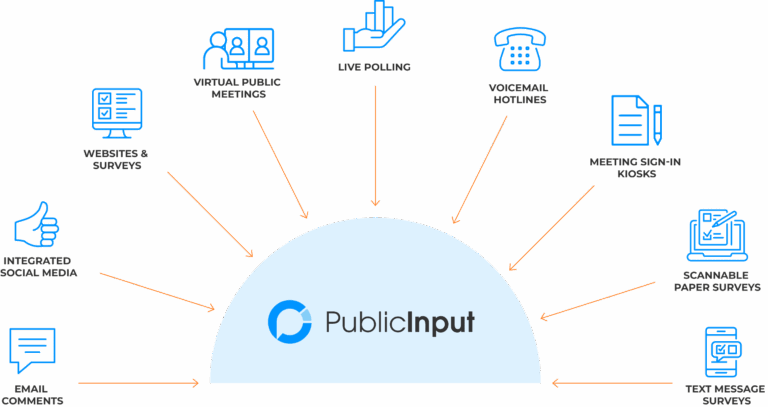
Agencies that standardize how engagement content is created and published reduce risk and support more equitable access across their communities. PublicInput supports this by centralizing how public-facing content is published across meetings, surveys, and outreach. The result: materials are structured and accessible by default, without requiring each department to manage formatting, translation, or document compliance on its own.
This does not replace ADA oversight. It strengthens it by reducing variability at the source.
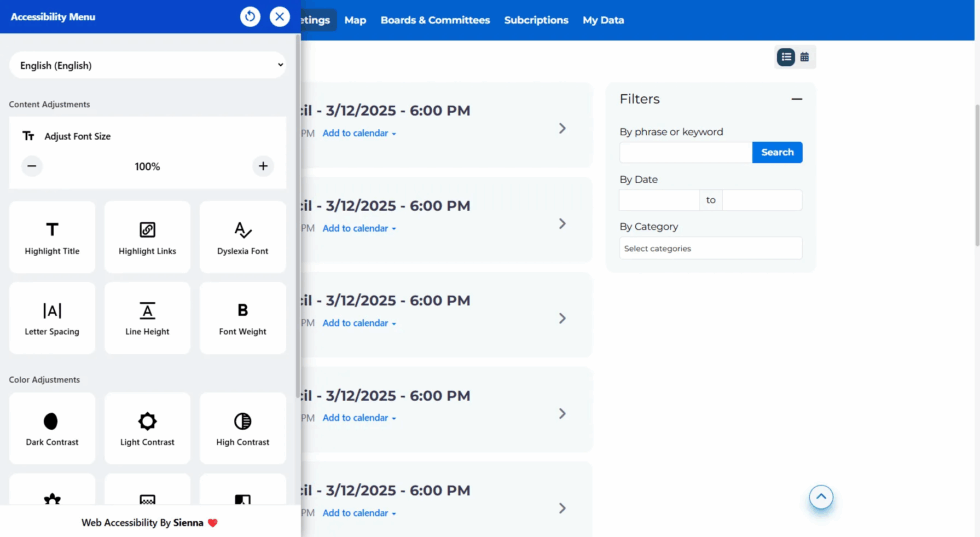
| Above Image: PublicInput’s accessibility widget extends usability for residents, and works best when the content beneath it is consistently structured and accessible by default.
What this means for ADA Coordinators
The role of ADA Coordinators is not to produce engagement content. It is to ensure that the systems producing that content are reliable, consistent, and aligned with accessibility requirements.
In practice, that means focusing on:
- Cross-department consistency in how content is published
- Risk patterns that repeat across tools and workflows
- Procurement and platform decisions that impact accessibility outcomes
- Long-term defensibility of accessibility practices across the agency
The goal is not to review every piece of content. The goal is to ensure fewer issues appear in the first place.
Consistency is what makes accessibility defensible
At its core, accessibility compliance is about reliability.
When engagement is consistent:
- Public information is easier to access and understand
- Compliance risk is reduced across departments
- ADA Coordinators can respond to inquiries with confidence
- Agencies can demonstrate sustained compliance over time
Consistency does not eliminate responsibility. It strengthens it.
If your agency is ready to build a more consistent accessibility foundation across public engagement workflows, PublicInput can help you get there.