North Carolina DOT – Modernizing Public Engagement for the STIP

Centralizing communication to build trust, transparency, and efficiency
Background
Every two years, the North Carolina Department of Transportation (NCDOT) updates the State Transportation Improvement Program (STIP), setting a 10-year roadmap for transportation projects across the state. In summer 2025, the latest cycle began, inviting stakeholders to submit project ideas for scoring, evaluation, and ultimately funding allocation.
The Challenge
Creating a STIP is no small feat. With hundreds of projects across 100 counties competing under three funding tiers (Statewide Mobility, Regional Impact, and Division Needs) NCDOT must balance regulatory compliance, equity, and transparency.
Historically, several practical hurdles have made achieving these goals challenging:
- Fragmented outreach: Information lived across press releases, PDFs, and GIS maps, leaving residents unsure where to go or how to weigh in.
- Accessibility barriers: Traditional outreach methods often missed low-income, rural, and non-English-speaking residents.
- Staff burden: Feedback poured in through multiple channels (emails, voicemails, meetings) forcing staff to manually match comments to the right projects.
- Continuity gaps: Since STIP cycles span years and multiple phases, comments and contacts were often siloed, making it difficult to maintain a complete, reliable history of public engagement.
The outcome? Residents couldn’t participate meaningfully, and staff found themselves drowning in incomplete data and overwhelming administrative tasks.
Modernizing STIP Engagement with PublicInput
To meet these challenges, NCDOT adopted PublicInput as the central platform for all public-facing STIP activities. By consolidating outreach and feedback into one system, the agency built a single, trusted hub where residents can access project information, participate in surveys, and provide comments at every stage of the process.
This centralized approach has delivered:
- Transparency and accountability: Public input is documented and visibly to project decisions.
- Streamlined workflows: Surveys, comments, and analytics flow into one system, reducing staff burden and making data actionable.
- Equitable access: Surveys are available in English and Spanish, supported by interactive maps and searchable project pages that make exploration intuitive.
- Real-time insights: Participation data, referral sources, and demographics are tracked continuously, helping staff spot gaps and adjust outreach strategies on the fly.
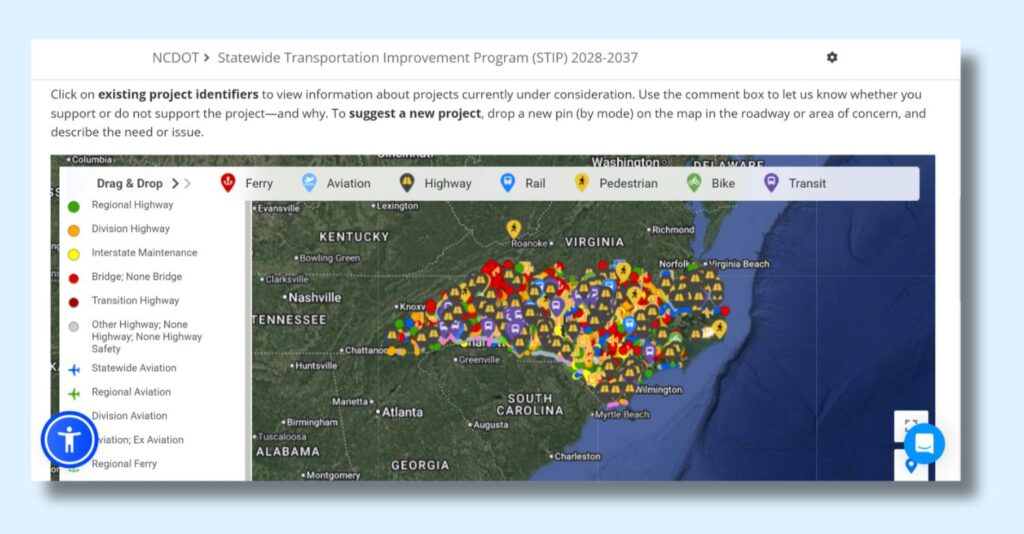
Image Below: PublicInput’s interactive map-based questions offer residents a way to recommend projects, giving NCDOT real-time insight into local priorities across the state.
NCDOT also introduced a new way for residents to directly influence priorities through an interactive STIP prioritization tool built from PublicInput’s Budget Simulator.
Rather than just reviewing static project lists, residents could “allocate” limited funds across competing projects, boosting those they valued most while scaling back others. This hands-on approach reflected the same trade-offs decision-makers face, showing impacts in real time.
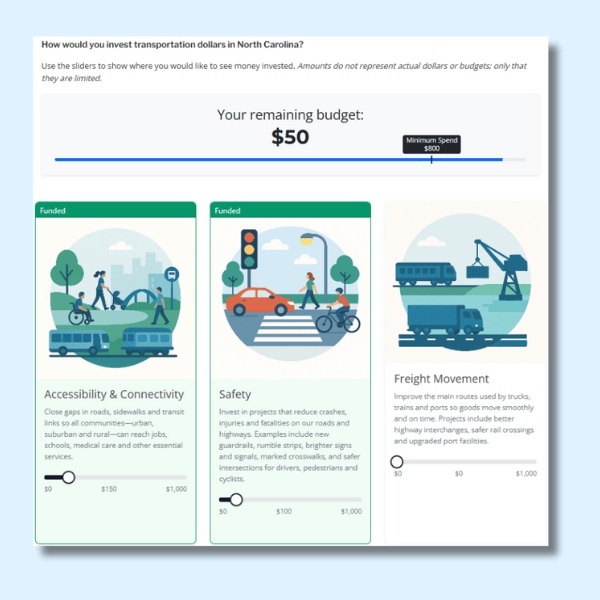
The result was a more engaging, educational experience for residents, and more quantitative, defensible data for staff. Instead of siloed comments, NCDOT can now clearly show how community preferences shaped prioritization—building trust and making decisions easier to explain to leadership and the public alike.
Early Results: Building a Transparent, Data-Driven STIP
For the 2028–2037 cycle, NCDOT leveraged PublicInput to create a centralized, accessible, and equitable STIP engagement process. The results show:
- Strong participation: Residents contributed over 11,202 survey responses and 2,495 comments.
- Active engagement reach: STIP content was viewed over 7,000 times, with 2,124 residents subscribing for updates.
- Actionable prioritization: Using the STIP prioritization tool, residents allocated funding across competing projects, generating quantitative input that directly informs decision-making.
- Equity and representation insights: 9% of respondents identified as a racial or ethnic minority, and 11% reported a disability, helping staff pinpoint gaps and target outreach more effectively.
- Enhanced trust and transparency: Residents can see how their feedback shapes project decisions, reinforcing public confidence.
- Improved operational efficiency: Centralized data and real-time analytics reduce administrative workload and allow staff to focus on strategic engagement.
These early results demonstrate that NCDOT’s approach is making the STIP process more transparent, interactive, and equitable, while providing a replicable model for data-driven, inclusive transportation planning.
Take Action: Modernize Your STIP Prioritization
NCDOT’s approach shows how centralized engagement and interactive prioritization tools can transform multi-year transportation planning. Agencies can use these strategies to:
- Engage residents more equitably across diverse communities
- Turn trade-offs into data-driven insights
- Reduce staff workload while staying compliant
Learn how STIP prioritization with the Budget Simulator can modernize your public engagement and provide defensible guidance for decision-makers.