VIA Transforms Bus Route Outreach in San Antonio Using Mobile, Data-Driven Canvassing
VIA Metropolitan Transit in San Antonio received the Excellence in Data-Driven Engagement Award for leveraging technology to deliver equitable neighborhood outreach during proposed bus route changes. This case study shows how VIA turned resident input into actionable insights while maximizing participation and equity..
Community Profile: San Antonio, Texas
VIA Metropolitan Transit serves San Antonio and surrounding municipalities in Bexar County, home to roughly 1.5 million residents, with 38% identifying as people of color. About 16% of residents live below the poverty line, and neighborhoods vary widely in density, income, and mobility needs, making inclusive, accessible outreach essential for effective transportation planning.
The Challenge of Equitable Transit Engagement
VIA faced the complex task of gathering input on major proposed changes to their Green and Silver bus lines, with a priority on reaching communities most dependent on transit. Traditional outreach methods like public meetings and online surveys risked leaving households unengaged, especially across the extensive corridor with a limited outreach team.
To ensure every neighborhood had a voice, VIA turned to door-to-door engagement, aiming to capture meaningful, actionable feedback while maintaining equity and inclusivity across the service area.
How PublicInput Was Used
VIA leveraged PublicInput to create a field-ready command center, turning its door-to-door canvassing operations into a fully coordinated, data-driven effort. Mobile-optimized surveys allowed block walkers to record household visits and collect feedback in real time, while live reporting and mapping highlighted coverage gaps and guided dynamic redeployment of staff.
Meanwhile, the PublicInput CRM automatically captured participant addresses, consolidated responses, and eliminated duplicate entries—removing hours of spreadsheet work and ensuring clean, actionable data before the team returned to the office.
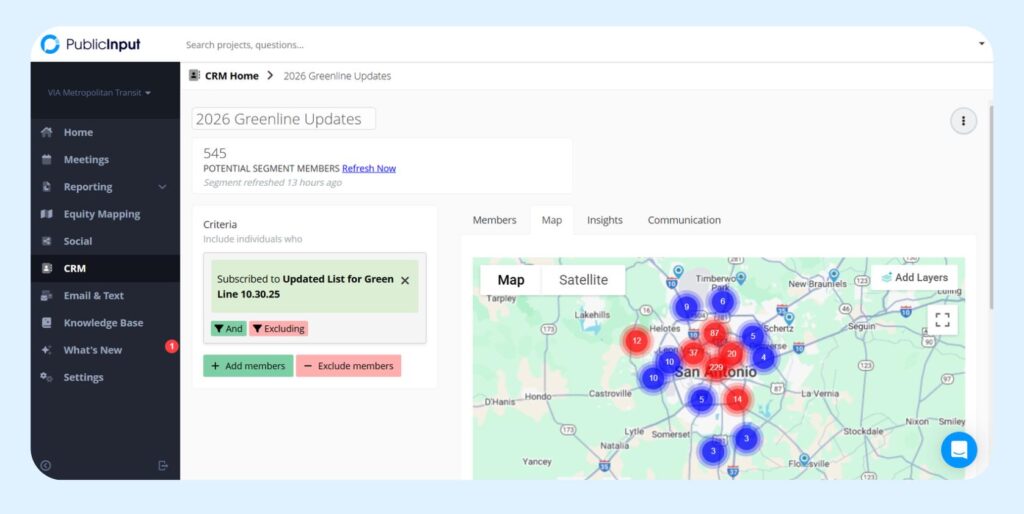
Adoption was seamless, with block walkers quickly adjusting to mobile survey tools. By integrating real-time tracking, data consolidation, and mobile reporting, PublicInput enabled VIA to maintain full visibility across neighborhoods, maximize participation, and ensure equitable outreach for communities most reliant on transit.
The Results: Data-Driven Canvassing that Reaches Every Neighborhood
VIA’s use of PublicInput transformed bus-route outreach into a structured, neighborhood-level operation—capturing resident priorities, ensuring equitable participation, and giving decision-makers actionable insights.
Neighborhood Participation and Community Impact
- Green Line canvassing reached 8,466 residents; Silver Line outreach engaged 6,278.
- Real-time progress tracking ensured outreach reached households across all targeted corridors.
- Resident feedback highlighted priorities like route accessibility and service reliability, shaping proposals that truly reflect transit-dependent communities.
Operational Efficiency and Data Clarity
- Mobile surveys and CRM mapping eliminated manual spreadsheets and duplicate entries.
- Staff could dynamically redeploy to coverage gaps, maintaining equitable outreach.
- Consolidated, accurate data enabled rapid analysis and informed decision-making.
Scalable, Repeatable Field Engagement
- The approach created a repeatable, field-ready model for future transit projects.
- Full geographic coverage ensured all neighborhoods—including traditionally harder-to-reach areas—were included.
- Real-time visibility empowered VIA to adjust strategies on the fly, maximizing participation and equity.
By turning PublicInput into a mobile, data-driven canvassing system, VIA set a new standard for neighborhood transit engagement, ensuring transit-dependent communities had a meaningful voice in planning and setting a new standard for equitable, operationally efficient engagement.
Transform Transit Engagement in Your Community
VIA’s success shows how mobile surveys, real-time reporting, and CRM mapping can turn neighborhood outreach into a scalable, data-rich process.
Want to explore how your agency can achieve full coverage, engage every household, and make transit planning more equitable?