Taming the Hybrid Public Meeting Chaos: A Unified Approach to Speaker Management

Picture this: it’s 6:58 PM, two minutes before your public meeting goes live.
You have a clipboard of in-person speaker sign-in sheets, a Zoom window with a dozen raised virtual hands, and a phone line with an unknown number of callers waiting to comment — all on three different screens. Your job is to call each speaker in a fair, orderly sequence while ensuring every remote participant is legally “seen and heard.”
If this sounds familiar, you’re not alone. For government clerks across the country, hybrid meeting chaos isn’t a hypothetical — it’s every meeting night.
The Challenge: When Three Queues Become One Nightmare
Hybrid public meetings were supposed to broaden access to local democracy. And they have. But for the clerks responsible for running those meetings, the logistical reality has been a different story entirely.
Managing speaker participation across disconnected systems creates cascading problems in real time:
- In-person attendees sign in on paper
- Virtual attendees raise their hands on a video platform like Zoom or WebEx
- Phone-in callers wait on a separate line, often with no integrated tracking
- No unified queue means clerks bridge the gap – live, under public scrutiny.
The result isn’t just operational stress. It creates real risk:
- Skipped speakers
- Dropped callers
- Inconsistent participation opportunities
- Unequal access to public comment
And those breakdowns can trigger compliance concerns under state open meetings laws like California’s Brown Act or Florida’s Sunshine Law. When access isn’t clearly demonstrated, agencies risk legal challenges, nullified decisions, and costly litigation.
A Unified Public Meeting Dashboard: One Queue to Manage Them All
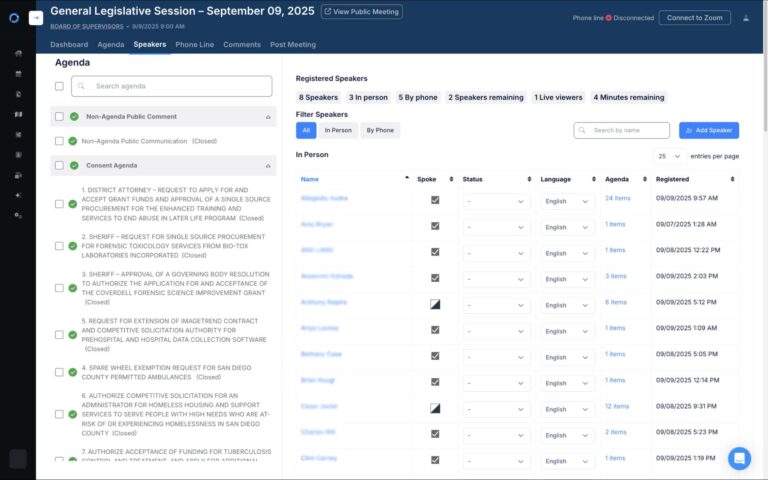
The answer to fragmented speaker management isn’t working harder across multiple systems — it’s working smarter within one. PublicInput Meetings‘ Unified Speaker Management Dashboard brings every participant into a single, organized queue, regardless of how they’re joining.
Whether a resident walks into the meeting chambers, clicks “raise hand” from their living room, or dials in from their car, they appear in the same dashboard — sequenced, tracked, and ready to be called. The platform supports up to 250 phone-in speakers, making it viable even for high-attendance meetings on contentious agenda items.
For clerks, this means no more toggling between tabs, no more paper sign-in reconciliation, and no more uncertainty about who’s next in line. The queue is visible, manageable, and consistent — all from one place.
The “Seen and Heard” Requirement: More Than a Best Practice
Many states have specific statutory requirements that remote members of legislative bodies must be both seen and heard in order for their participation — and their votes — to count. This isn’t a formality. It’s a legal threshold, and failing to meet it can invalidate official actions taken during a meeting.
PublicInput Meetings addresses this directly through its two-way remote participation integration, designed with “seen and heard” hybrid compliance built in. The platform integrates with tools like Zoom and WebEx while simultaneously broadcasting to a public-facing Engagement Hub, ensuring that remote participants are visibly and audibly present in the official record. In-person and remote speakers are managed in the same unified queue, so no participant is inadvertently deprioritized or overlooked.
This is the difference between a meeting that feels hybrid-friendly and one that is legally, verifiably hybrid-compliant.
The Outcome: Smooth, Fair, and Stress-Free
When speaker management is unified, the entire public comment period transforms. Clerks can focus on facilitating participation rather than firefighting logistics. Members of the public — whether in the room or joining remotely — experience a consistent, equitable process. And leadership gets the assurance that the meeting record is complete, compliant, and defensible.
Hybrid public meetings don’t have to mean hybrid chaos. With the right tools, public meetings can become something better: a community engagement experience that’s truly accessible to everyone and confidently managed by the staff who make it possible.
Ready to bring order to your hybrid meetings? Learn how PublicInput Meetings can help.