Where Do You Even Start? A Framework for Planning Community Engagement

Every new engagement effort starts the same way: a brief lands on someone’s desk, a deadline is attached to it, and a blank project page is waiting to be filled in. Before a single survey question gets written, someone has to answer a handful of questions that never make it into the final report, but shape everything that follows. Skip them, and the project still gets built. It just gets built on guesswork instead of a plan.
The Questions That Should Come Before the Survey
Three decisions belong at the start of every project, not somewhere in the middle once a draft is already circulating for review.
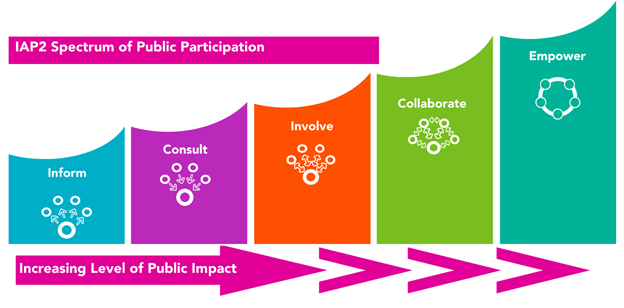
Where does this sit on the spectrum of public input? Not every project calls for the same level of involvement. A resurfacing schedule is different from a rezoning decision, and a rezoning decision is different from a long-range plan that will shape a decade of investment. The IAP2 spectrum, running from Inform through Consult, Involve, Collaborate, and Empower, gives that judgment call a shared vocabulary. Naming the level up front sets the tone for every question that follows and keeps the team from over- or under-asking.
Who actually needs to weigh in? A capital project touching one corridor has a different audience than a citywide comprehensive plan. Deciding this early, rather than reverse-engineering it from who happened to show up, is what determines whether the input a project collects looks like the community it’s meant to represent.
How will this input actually be used? Is it shaping a formal decision, informing a service change, setting a budget direction, or something else? Residents can tell when a survey is a formality versus when their answers will move something. Deciding this before the first draft goes out is what makes the difference visible to them, too.
None of this is complicated. It’s just easy to skip when the deadline is closer than the plan, and it’s the first place inconsistency creeps into an engagement program, one project answering these questions carefully and the next one skipping straight to survey questions.
Why This Work Falls on Whoever’s Running the Project
Most local governments don’t have a dedicated community engagement specialist on staff. Communications, planning, and transportation teams absorb engagement as part of a broader job description, not as the whole job. And not every project justifies bringing in a consultant to structure it, a lane resurfacing or a small area plan doesn’t carry the budget or the timeline for that.
So the thinking happens anyway. It just happens alone, from memory, by whoever drew the project this time, with whatever framework they happened to retain from the last one. “More staff” is consistently the top wish on every survey we run of engagement teams, and it’s not coming. Until it does, the practical answer has less to do with headcount and more to do with not redoing that thinking from scratch, unsupported, on every single project.
A Starting Point That Travels With You
Skipping this thinking usually has nothing to do with priorities. Whoever solved it last time didn’t write it down anywhere lasting, so the framework, the list, the hard-won lesson leaves with them, and the next project opens to the same blank page.
Giving that thinking a permanent home changes the pattern: a shared record of the organization’s standards, past projects, templates, and FAQs that the next person inherits instead of reconstructing. The work compounds instead of resetting.
Typing a faster survey was never really the point. The actual efficiency shows up in picking up where the last project left off, rather than building a starting point from nothing each time.
We’re working on making that starting point even easier to reach. More on that soon.
See what a shared starting point could look like for your team.