Resident Engagement CRM: Building a Unified Record of Community Participation

Most agencies doing public engagement work are building relationships with their communities. The challenge is that those relationships don’t always get recorded in a way that persists. A resident attends a public meeting about a transportation corridor. Six months later, a different team in the same agency launches an unrelated project in the same neighborhood. Nobody knows that resident has already been engaged, what they said, or whether they were reached through the earlier outreach. The process starts over.
That’s not a staffing failure. It’s a systems gap. And it’s what a resident engagement CRM built for government is designed to solve.
What Is a Resident Engagement CRM?
A resident engagement CRM is a unified resident database that captures who participated in government engagement activities, through which channel, on which project, and what their stated interests and concerns were. It’s the institutional memory of an agency’s engagement program.
This is a meaningful distinction from a general-purpose CRM. Commercial tools like those used in sales and marketing are built around pipeline stages, lead scoring, and conversion tracking. They’re useful for the contexts they were designed for. Government engagement has different requirements: participation history across projects, demographic and geographic context, channel-level detail, and cross-project continuity that survives staff transitions.
Practitioners who rely on this kind of system include local government communicators, community engagement managers, and project leads at local governments, DOTs, and MPOs. What they share is a need to know not just who is in their database, but who has been engaged, when, on what, and through which channel.
Why a General CRM Falls Short for Government Engagement
General-purpose CRM tools are built for a different workflow. The gaps aren’t about features. They’re structural. Three problems show up consistently when agencies try to manage resident engagement through tools not built for the purpose.
- No Engagement Structure. A commercial CRM tracks contacts, activities, and pipeline stages. It doesn’t have a concept of a public comment period, a project-specific survey, or a formal meeting participation record. When staff try to use those tools to manage engagement, they’re building workarounds: custom fields, manual tags, separate spreadsheets, that create the same fragmentation problem the CRM was supposed to solve.
- No participation history by channel. Knowing a resident exists in the database is different from knowing they attended a public meeting, submitted an online survey, called the phone line, and were contacted via SMS, all on the same project. That channel-level detail is what makes it possible to understand how different populations prefer to engage and whether the agency’s outreach strategy is reaching the right people.
- No equity or demographic context. Commercial CRMs don’t capture the geographic and demographic data agencies need to assess whether outreach reached representative populations. Without that layer, it’s impossible to systematically identify who hasn’t been engaged and close those gaps intentionally before the next project.
A contact list and a participation record are not the same thing. The first tells you who you know. The second tells you whether your community engagement is actually working.
What a Resident Engagement CRM Covers
A purpose-built resident engagement CRM changes what’s possible across the full engagement lifecycle, not just during outreach, but across projects and over time.
The foundation is a unified resident database. Every resident’s participation history across all projects and channels lives in one record: name, geography, engagement history, contact preferences, sentiment, and subject interests. Nothing is siloed in a project folder or a personal inbox.
Online and offline resident outreach feeds directly into the CRM record. Every outreach attempt, every response, and every channel used is captured alongside the project it relates to. When a staff member needs to understand how a neighborhood was engaged on a prior project, the answer is in the system.
Cross-project continuity is what makes the CRM genuinely valuable over time. When a resident participated in a long-range transportation plan that is now relevant to a new corridor study in the same area, the system surfaces that history. Prior input doesn’t disappear. It compounds.
Segmentation by geography, demographics, and engagement history makes targeted outreach possible without manual list-building for every new project. An agency can identify residents in a specific area who have previously engaged, identify underrepresented neighborhoods who haven’t been reached, or connect with stakeholders who have expressed interest in a particular issue and engage them strategically.
One of the biggest benefits is keeping knowledge in the organization. When staff members leave, their institutional knowledge about who has been engaged, what was said, and how relationships were built doesn’t leave with them. It stays in the system.
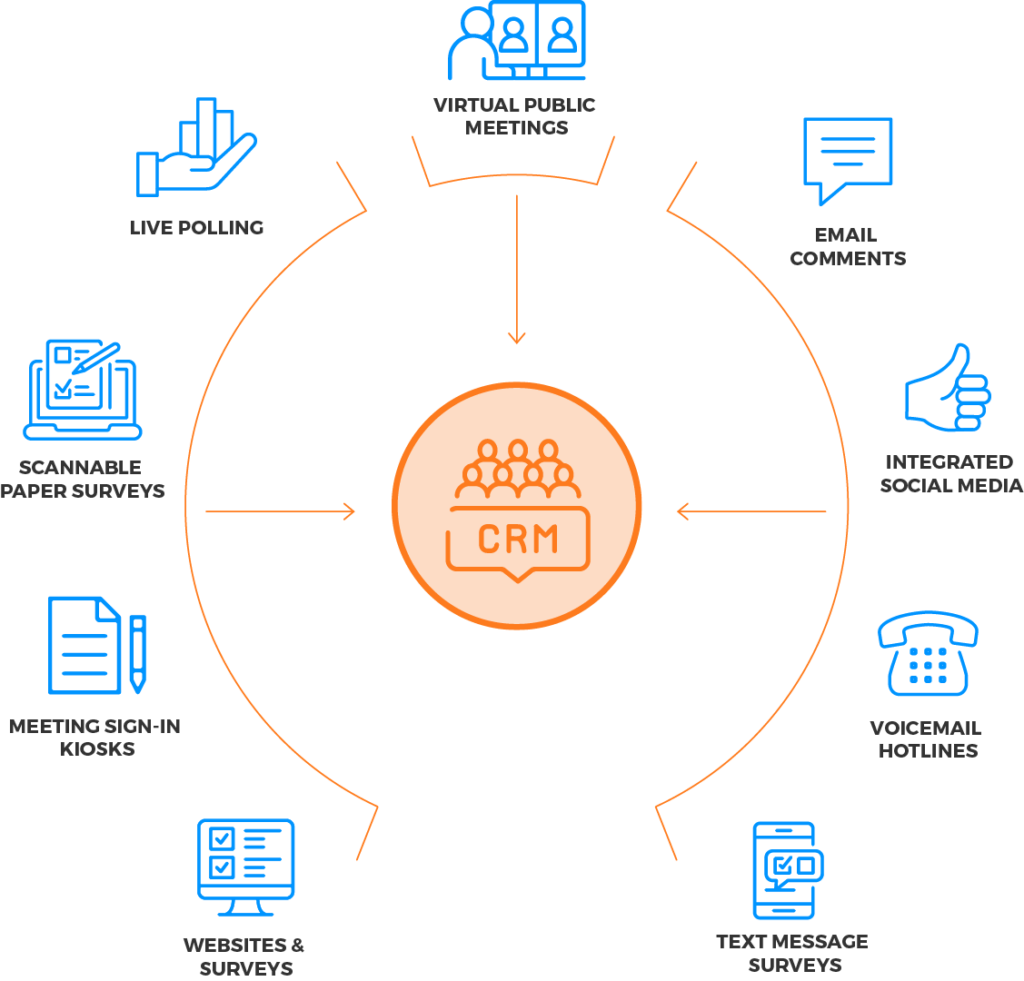
PublicInput’s resident engagement CRM preserves participation history across projects and channels, giving agencies a complete picture of who they’ve engaged and how.
Public engagement analytics and reporting sits on top of the CRM layer, turning that participation history into structured insight: demographic breakdowns, geographic coverage, and longitudinal patterns across projects.
Why Continuity Matters for Equity and Accountability
A unified resident record isn’t just an operational convenience. It’s what makes it possible to demonstrate that engagement was equitable and that underrepresented communities were meaningfully included, not just in one project, but as a sustained practice.
Without a persistent record, there’s no systematic way to identify who has and hasn’t been engaged across the community over time. Participation gaps that show up in one project may reappear in the next because there’s no mechanism to track them and close them intentionally.
When a regulator, an elected official, or a community advocate asks “did you engage this neighborhood?” or “when did you last hear from this stakeholder group?”, the answer needs to be in the system, not in someone’s memory or a spreadsheet that may no longer exist.
There’s a trust dimension as well. Residents who have participated before expect to be remembered. Re-engagement that acknowledges prior participation builds a different kind of relationship than starting from scratch.
It signals that the agency is listening not just in the moment, but over time.
Who Needs a Dedicated Resident Engagement CRM
The clearest indicator is any agency where engagement happens across more than one project, more than one team, or more than one staff generation.
Multi-project programs: Any agency managing concurrent or sequential engagement initiatives where stakeholder continuity matters across project timelines.
Equity reporting obligations: Any agency required to document demographic outreach history, particularly those operating under Title VI, federal grant requirements, or equity-based program commitments.
High staff turnover: Any organization where institutional knowledge about community relationships has been lost when staff members moved on.
Manual list management: Any team rebuilding outreach lists from scratch for each new project because there’s no central system connecting prior engagement to current work.
The Record That Makes Engagement Compound
Agencies investing in community engagement are building something over time: a network of relationships, a history of participation, a body of institutional knowledge about who their community is and how to reach them. The question is whether that investment is being captured.If the answer involves rebuilding lists, tracking down former staff, or starting fresh on every project, the value of prior engagement isn’t carrying forward the way it should. See how a resident engagement CRM built for government makes community participation a cumulative asset rather than a series of one-off events.