Partnering with Community-Based Organizations: Key Takeaways from Our December Customer Peer Exchanges

In December, PublicInput customers came together for our final peer exchange of the year to talk about a topic many agencies are actively grappling with: how to build and sustain meaningful partnerships with community-based organizations (CBOs).
Whether you joined us live or couldn’t make it, this recap highlights the practical insights, shared challenges, and emerging best practices that surfaced during the conversation—along with a look at how PublicInput’s CBO tools are evolving to better support this work.
Why CBO Partnerships Matter
Across agencies of all sizes and geographies, one theme was consistent: CBOs play a critical role in helping government reach residents who might otherwise be missed. These organizations often have long-standing relationships, cultural context, and trusted communication channels that agencies simply can’t replicate on their own.
Participants shared that their goals for CBO partnerships include:
- Reaching underrepresented or historically excluded communities
- Building trust through familiar messengers
- Creating engagement opportunities that feel relevant and accessible
- Moving from one-off outreach to longer-term collaboration
At the same time, many acknowledged that managing these relationships can feel fragmented and hard to sustain.
A Closer Look at the PublicInput CBO Module
The peer exchange included a high-level look at PublicInput’s Community-Based Organizations (CBO) module and network—framed not as a silver bullet, but as an attempt to make a very human, relationship-driven practice easier to manage over time.
Participants agreed: community partnerships often live in scattered spreadsheets, email inboxes, or individual staff members’ heads. When that happens, context gets lost and relationships are harder to sustain.
The PublicInput CBO module is designed to serve as a central system of record for these partnerships, bringing structure without stripping away flexibility.
Key capabilities discussed included:
A centralized place for partner relationships
Agencies can manage organizational details, key contacts, and areas served in one shared space—reducing reliance on disconnected spreadsheets and making it easier for teams to collaborate.
Access to a large, continuously updated CBO network
The CBO Network includes more than 500,000 community-based organizations, categorized using a standardized taxonomy. This gives agencies a strong starting point when identifying potential partners, rather than building lists from scratch.
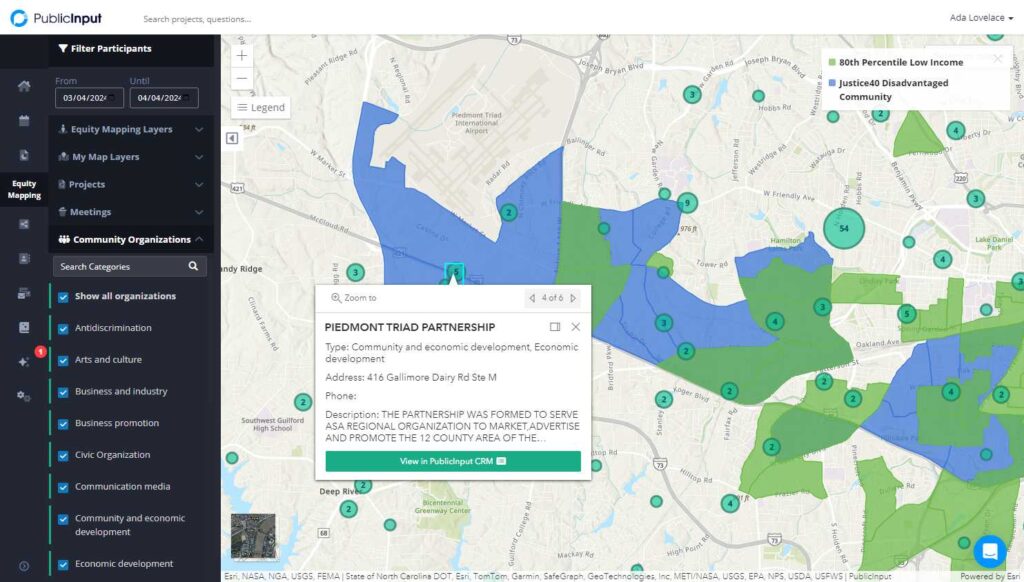
Geographic and equity-based visibility
Organizations can be viewed in list form or mapped alongside Equity Mapping layers and GIS data, helping agencies see where partners are located, identify gaps, and focus outreach on specific neighborhoods or service areas.
Better context over time
Teams can log interactions, associate multiple contacts with an organization, and track relationship history—supporting continuity even as staff, projects, or priorities change.
One analogy shared during the session resonated strongly: managing partnerships through scattered spreadsheets is like planning a road trip with a pile of postcards. You may have addresses, but without seeing them on a map, it’s hard to understand how they relate to one another. The CBO module functions more like a GPS—adding orientation, context, and clarity to help teams choose the most effective path forward.
What Peers Are Experiencing in the Field
During the peer discussion, customers were candid about where things feel challenging today. Words like scattered, varied, and still developing came up often when describing current CBO efforts.
A few common themes emerged:
Moving beyond cold outreach
Many agencies shared how time-consuming and discouraging it can feel to build partner lists from scratch—especially when it involves searching for emails online and sending cold introductions with uncertain results.
Being thoughtful about partner communications
There was strong agreement that more outreach isn’t always better. Agencies emphasized the importance of sharing information that is clearly relevant to a partner’s mission, rather than overwhelming organizations with every project or update.
Scale makes relationships harder
Regional and statewide agencies noted that building personal relationships can be especially difficult when serving large geographies with thousands of potential organizations. The challenge isn’t just finding partners—it’s prioritizing where to focus limited time and energy.
Practical Strategies That Are Working
Alongside challenges, participants also shared tactics that have helped them build stronger, more effective partnerships:
- Start with shared values. Reviewing a CBO’s mission and framing outreach around overlapping goals—such as community health, access, or safety—can help establish trust early.
- Be strategic about where you show up. Attending virtual meetings or events hosted by community groups can open doors to informal connectors and ambassadors who bridge gaps to harder-to-reach audiences.
- Use location and context to focus outreach. Aligning partners with specific project areas or community needs helps ensure outreach feels purposeful rather than generic.
- Think long-term. Viewing CBO relationships as ongoing partnerships—not just distribution channels—creates more sustainable engagement over time.
Looking Ahead
If you’re exploring ways to strengthen your CBO partnerships—or looking for more structure around how you manage them—we encourage you to connect with your PublicInput team to learn more about the CBO module and how other agencies are putting it into practice.
If you’re looking to take the ideas from this peer exchange further, there are a couple of ways to continue the work.
The CBO Engagement Playbook is a practical, customizable resource designed to help you assess your current approach, get organized, and strengthen how you work with community-based organizations over time. It’s a helpful next step if you’re ready to move from informal outreach to more intentional, sustainable partnerships.
You can also request a demo to see how the CBO module and network work in practice—from managing partner relationships to visualizing coverage alongside equity data. A walkthrough can help you understand what’s possible and how it might fit into your existing engagement workflows.
Thank you to everyone who joined the conversation this year. We’re grateful for the openness, ideas, and peer learning that make these exchanges valuable—and we look forward to continuing the conversation!