Charlotte’s Corridors of Opportunity: Community Engagement in Action

Recognized with the Champion of Inclusive Engagement Award, the City of Charlotte demonstrates how sustained, equity-focused engagement can shape meaningful investment in historically underinvested neighborhoods. This case study highlights how city leaders listened, adapted, and acted—turning resident input into tangible projects, inclusive programs, and long-term community trust.
Community Profile
Charlotte, North Carolina is located in the southern part of the state, near the border of South Carolina. As a major financial and logistics hub, Charlotte is home to several Fortune 500 companies and a growing number of technology and clean energy firms. With a population of over 897k, , it is the largest city in North Carolina and one of the fastest-growing cities in the Southeast.
Charlotte is a diverse community, with over 35% of residents identifying as Black or African American, 15% as Hispanic or Latino, and nearly 17% speaking a language other than English at home.
The Opportunity to Rebuild Trust Through Engagement
The City of Charlotte launched its Corridors of Opportunity initiative to guide investment in six historically underinvested corridors and ensure residents most affected by past disinvestment could help shape what came next. Spanning diverse neighborhoods with different languages, cultures, and lived experiences, the effort required more than traditional outreach to inform long-term revitalization.
City leaders understood that meaningful progress would depend on trust. With significant public and partner investment planned, Charlotte needed an engagement approach that consistently reached residents, reflected local priorities, and supported shared decision-making over time.
From Vision to Community Engagement Strategy: How PublicInput Was Used
To support sustained, equitable engagement across six corridors, Charlotte needed an approach that could scale, adapt, and remain accessible over time. PublicInput became the foundation for ongoing communication, feedback collection, and participation tracking across diverse communities.
How the City Engaged Residents
- Launched corridor-specific surveys and project pages with maps, visuals, and clear background context
- Enabled residents to subscribe by corridor to receive updates relevant to their neighborhood
- Delivered targeted email campaigns to keep residents and stakeholders informed as plans evolved
Designed for Accessibility
- All materials written at a sixth-grade reading level
- Content translated and culturally adapted for Spanish-speaking residents and other language groups
Using Data to Guide Outreach
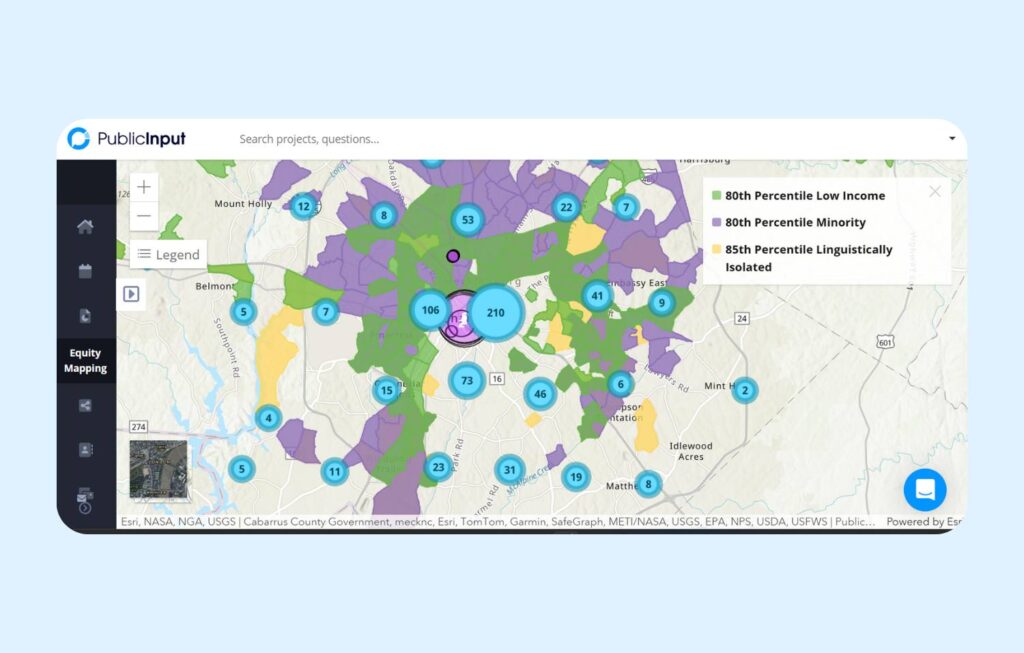
- Real-time demographic dashboards tracked participation by corridor
- Engagement data was used to identify gaps in representation
- Staff adjusted outreach strategies to better reach underrepresented communities
Supporting Long-Term Implementation
- Engagement data supported coordination across city departments and funding partners
- Input was collected continuously and carried forward as corridor playbooks moved into implementation
Rather than treating engagement as a one-time milestone, Charlotte used the platform as a long-term engagement infrastructure—keeping community priorities visible as plans progressed from vision to on-the-ground action.
The Results: Building Trust and Accelerating Impact
With the right tools and strategy in place, Charlotte was able to turn community input into real-world outcomes in order to build momentum, trust, and tangible progress across all six corridors.
Here are a just few outcomes realized following these efforts:
- Secured over $20 million in federal funding, including a $12M RAISE grant for the Sugar Creek Mobility Corridor
- Launched the Business Opportunity Hubs program, supported by a $4.4M federal grant to establish workforce development and small business spaces—one in each corridor
- Mobilized grassroots partners, with United Way distributing $3.86 million to 57 local organizations
- Used survey feedback to influence major capital decisions—like the redevelopment of hotels into supportive housing in Sugar Creek
- Advanced projects in tree canopy management, pedestrian safety, and e-mobility
By centralizing efforts and leveraging real-time insights, the Charlotte team was able to demonstrate how resident input directly influenced outcomes—helping rebuild trust, increase participation, and ensuring that Charlotte’s growth was shaped by those living it.
Plan for Equity, Engage with Intention
Charlotte’s Corridors of Opportunity initiative shows what’s possible when cities commit to long-term, inclusive engagement strategies. From securing funding to implementing on-the-ground projects, success was built on listening deeply and planning collaboratively.
If your agency is tackling long-term revitalization, racial equity, or neighborhood development, consider how a centralized platform like PublicInput can amplify voices, track impact, and build trust over time. The journey begins with a conversation—start yours today.