Public Meeting Management Software for Accessible Hybrid Meetings

Public meetings are one of the key opportunities for governments to demonstrate that community voices matter. When they’re run well, they build trust. When the tools make it hard to participate, document, or follow up, that opportunity is harder to realize than it should be.
Most agencies understand what a well-run meeting looks like. The challenge is that the platforms available for hybrid and virtual meetings were designed for a different context, and the gaps between what those tools provide and what a public meeting requires aren’t always visible until something goes wrong.
Accessible public meeting management built for government is designed to bridge that gap, bringing every participation channel, every comment, and every record into one connected process.
What Is Public Meeting Management Software?
Public meeting management software is a platform built specifically to run government public meetings and hearings. The distinction from general video tools isn’t primarily about features. It’s about design intent.
Platforms built for government assume that compliance, accessibility, multilingual access, and defensible records aren’t optional upgrades. They’re the foundation. Everything else is built on top of that.
The agencies that rely on this kind of software run formal public processes: planning commissions, transit boards, utility commissions, public works departments, councils. Any body that holds hearings where public comment is part of the official record.
Where General Video Tools Fall Short
General video conferencing tools were designed for internal collaboration. They do that well. Public hearings require something different, and the gaps appear in predictable places.
- Phone access challenges: Participants calling in may struggle with web-based registration or joining the meeting.
- Limited accessibility: ADA accommodations like CART captions and screen reader support are not built into standard workflows.
- No native multilingual support: Live interpretation must be coordinated manually, creating extra staff work.
- Non-compliant chat logs: Chat messages aren’t automatically part of the legal meeting record.
- Speaker queue management gaps: Staff often manage in-person, virtual, and phone queues separately using spreadsheets.
- Transcription issues: Auto-generated transcripts require significant cleanup before they are usable for records or reporting.
The tool stack isn’t just inconvenient. It’s a documentation problem. And documentation problems become legal problems.
Each workaround adds coordination burden and introduces a point of failure. Taken together, they create the conditions for a complaint that’s difficult to defend against: an agency that held a hearing, but can’t prove it was conducted fairly.
What Hybrid Public Hearings Actually Require
A compliant, accessible hybrid hearing isn’t defined by which platform it runs on. It’s defined by what every participant can do, regardless of how they join.
In-person and remote attendees need to be on equal footing. Both should be able to hear the proceedings clearly, submit comments, and be recognized to speak. The platform should make that parity automatic, not something staff have to manually coordinate across two separate interfaces.
ADA-compliant access means real-time captions accurate enough to be useful, screen reader compatibility, and accommodation options built into the standard workflow, not requested as a special exception. Online and offline resident outreach tools extend this further, reaching participants who may never join a formal meeting at all.
Multilingual support means translated agendas and instructions, multilingual interface options, and a pathway for non-English-speaking participants that doesn’t require them to seek out a separate accommodation process.
Phone-in access needs to be a first-class participation channel, not a fallback. For many residents, including those without reliable broadband, a smartphone, or comfort with video platforms, the phone line is the most practical way to participate. It should work as well as any other option.
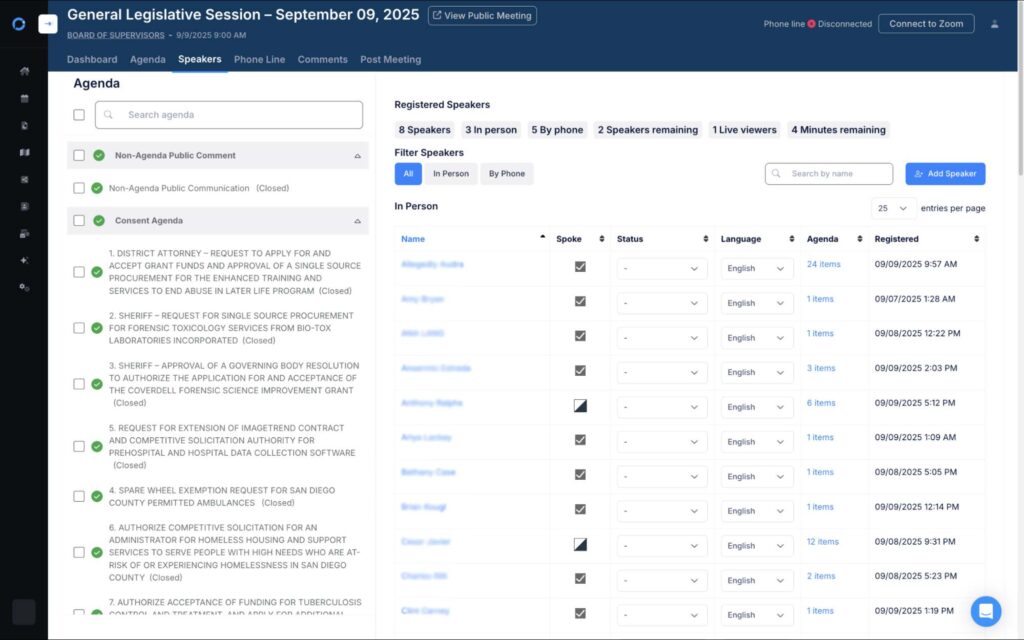
Speaker queue management should run in a single dashboard covering in-person attendees, virtual participants, and phone-in callers together. Not three separate lists that staff manually reconcile.
Automated transcription should produce a record accurate enough to be useful without significant manual editing, tied to the meeting record, and exportable in formats suitable for formal review.
Accessible doesn’t mean accommodating edge cases. It means designing for the full range of people your agency is obligated to serve.
Documentation That Holds Up
The post-meeting record is where compliance is made or broken. Most agencies know they need one. Fewer have a clear picture of what it actually needs to include.
A defensible meeting record has a full audio and video archive tied to the meeting record, not sitting separately in someone’s Zoom account. It has a verbatim or near-verbatim transcript, not a raw auto-caption export with speaker names missing. It has a structured comment log tied to agenda items, so it’s clear which input was received in response to which item. It has an attendance and participation record by channel. And it has a clear chain of custody for all public input from collection through storage.
This matters for open records requests. It matters for project challenges. And it matters for the quieter but equally important question that comes up constantly: can we show that this process was fair?
Public engagement analytics and reporting tools take that documentation further, turning meeting records into structured insights that can inform decisions and demonstrate accountability.
When You Need Dedicated Meeting Software
The clearest indicator is any meeting or hearing where the outcome could be questioned. In practice, that covers most formal public processes.
Official record: If public comment is part of the official record, a general video tool isn’t adequate documentation infrastructure.
Regulatory coverage: If the process is covered by NEPA, CEQA, Title VI, or ADA requirements, the compliance bar is specific and enforceable.
Language access: If the community includes a significant non-English-speaking population, language access isn’t optional. It’s a legal requirement.
Contested decisions: If the decision is likely to be challenged, the record will matter. Having it organized and complete from the start is far easier than reconstructing it later.
For local government engagement teams and transportation agencies, most public meetings clear at least one of these thresholds. The question isn’t usually whether dedicated software is warranted. It’s whether the current setup is actually meeting the standard it’s being held to.
Meetings That Work for Everyone
Public hearings carry real legal and civic weight. The tools used to run them should reflect that.
The staff burden of managing disconnected tools is real, and it’s a distraction from the actual work of listening and responding to the community. Purpose-built software addresses both at once: it reduces the coordination overhead and keeps the record organized throughout the process, not just at the end.If your agency is managing public meetings across disconnected tools, there’s a better way to work. See how accessible public meeting management built for government changes what’s possible, for staff and for the communities they serve.