Community Engagement Software for Government Agencies

Many agencies are doing meaningful engagement work. The challenge is that the tools available often make that work harder than it needs to be, and the gap between effort and outcome is usually a systems problem, not a staffing one.
Public engagement is complicated. Agencies are managing projects, channels, and resident expectations, often with small teams. The goal has always been the same: connect with residents, collect meaningful input, and make decisions that reflect what communities actually said. But when tools aren’t built for that full process, the full coordination burden falls on staff.
Community engagement software built for government is designed to change that, bringing outreach, input collection, meeting management, and reporting into one efficient and connected process.
What Is Community Engagement Software?
Community engagement software is a purpose-built platform that helps government agencies collect, manage, and respond to public input across projects and initiatives, from initial outreach and engagement through analysis and reporting.
The category is broad by design. Government engagement isn’t one activity. It spans community outreach, project-specific surveys, public meetings, comment periods, stakeholder communication, and documentation across all of it. A platform built for this work connects those pieces rather than treating each one as a separate problem to solve.
The agencies that rely on this kind of software include local government engagement teams managing long-running community processes around zoning, comprehensive plans, and capital projects. Transit agency engagement and DOT and MPO engagement programs navigate federal Title VI requirements and multi-year transportation planning processes. Councils of government engagement teams coordinating participation across multiple jurisdictions. The projects look different. The core challenges, reaching diverse communities, organizing feedback clearly, meeting equity and accessibility obligations, and producing a defensible record, are shared.
The Real Cost of a Disjointed Approach
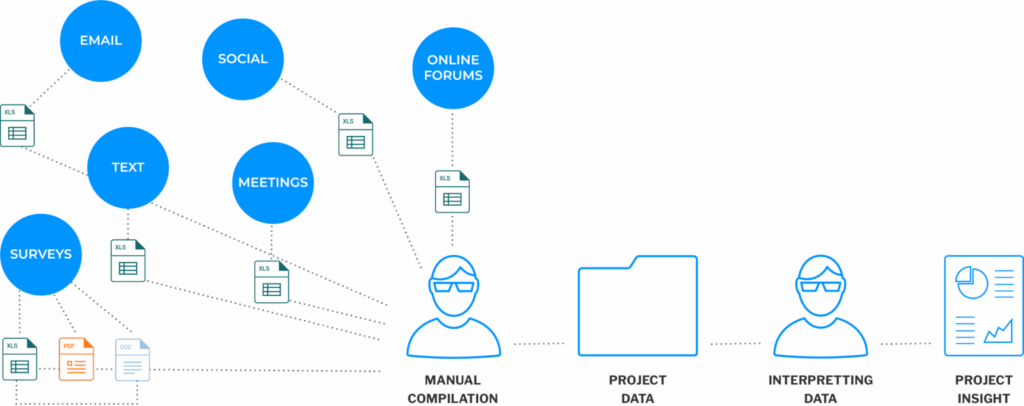
Most agencies don’t set out to build a fragmented process. It happens incrementally: a tool added for one project, a workaround adopted under deadline pressure, a spreadsheet that became institutional habit. Over time, the patchwork hardens into the default.
The cost shows up in three compounding ways.
No unified record. Comments live in one system. Meeting notes in another. Survey results in a spreadsheet that one person maintains. Participant data, including names, districts, and subject interests, scattered across platforms with no common thread. When an open records request arrives, the result is an inefficient scramble to locate, reconcile, and produce information that should be immediately accessible.
Managing engagement across disconnected tools creates fragmented records, duplicated effort, and gaps that are difficult to recover from later.
Invisible barriers. Zoom doesn’t serve residents without reliable broadband. Google Forms doesn’t accommodate non-English speakers or residents with disabilities. Resulting in data that comes back reflecting who could easily participate, not who the decision actually affects.
Staff overload. Every project becomes a manual coordination effort. Outreach, input collection, meeting logistics, and analysis each require their own workflow. Institutional knowledge lives in individual inboxes, not in a system that outlasts any one person on the team.
The tool stack isn’t just inefficient. It’s a liability.
What a Purpose-Built Platform Covers
A well-designed community engagement platform doesn’t replace judgment or relationships. It handles the infrastructure so staff can focus on the work that actually requires human attention.
That infrastructure spans the full engagement lifecycle.
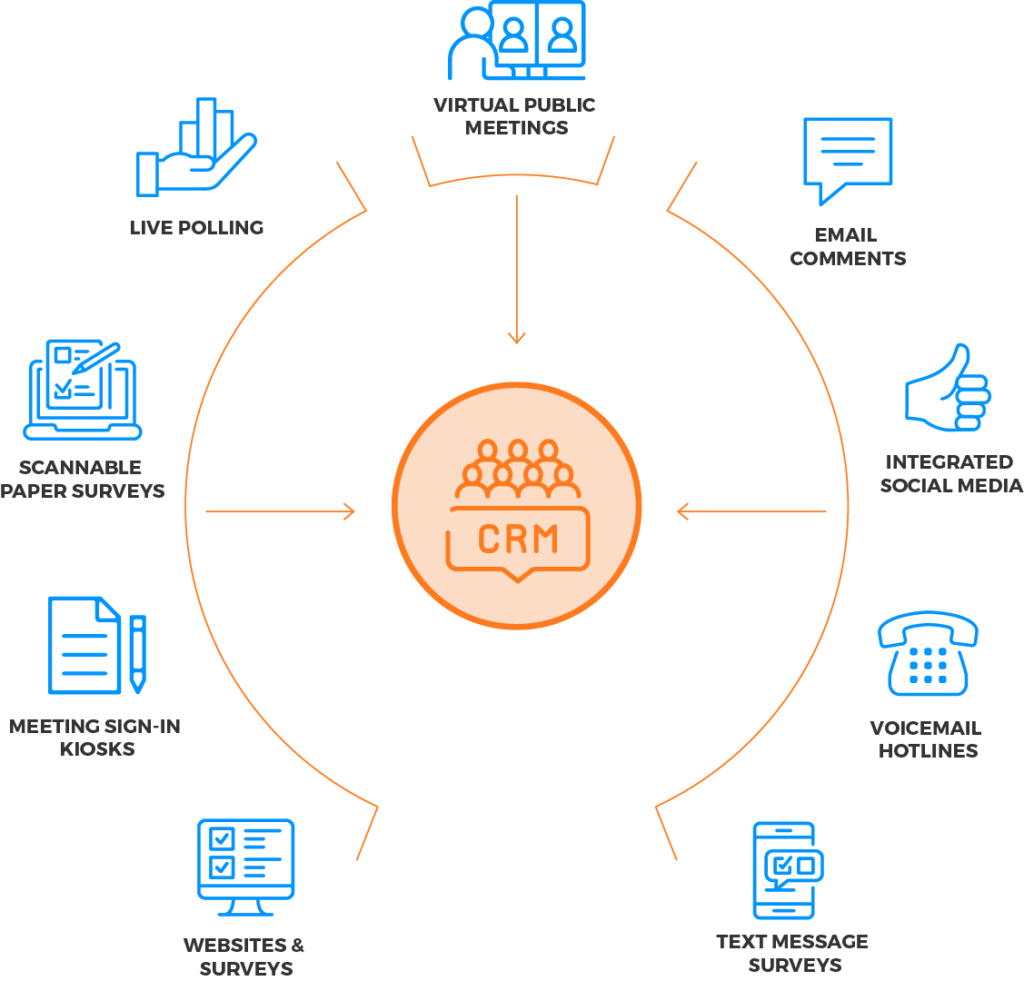
It starts with government survey and project tools: structured engagement portals, project pages, surveys, interactive maps, and subscription forms that capture input in context from day one. Every response is tied to a project, a channel, and a timestamp. Nothing gets lost in a shared folder.
It extends to online and offline resident outreach, reaching residents using email, SMS, phone, social media, QR code, and in-person tools, not just the channels that are easiest to manage. The residents most affected by a decision are often the hardest to reach through digital-only approaches.
It includes accessible public meeting management: hybrid and virtual meetings with structured speaker queues, real-time captions, multilingual support, automated transcription, and meeting records that hold up under formal review.
After input is collected, it needs to mean something. Public engagement analytics and reporting turns raw comments and survey responses into structured insights, including theme clustering, demographic breakdowns, geographic analysis, and export-ready reports that decision-makers can actually use.
And underneath all of it, a resident engagement CRM preserves engagement history across projects, so the agency knows who it has heard from, when, on what, and through which channel. That continuity survives staff turnover and project transitions.
When these pieces live in one platform, the whole process changes, not just for staff, but for the communities they serve.
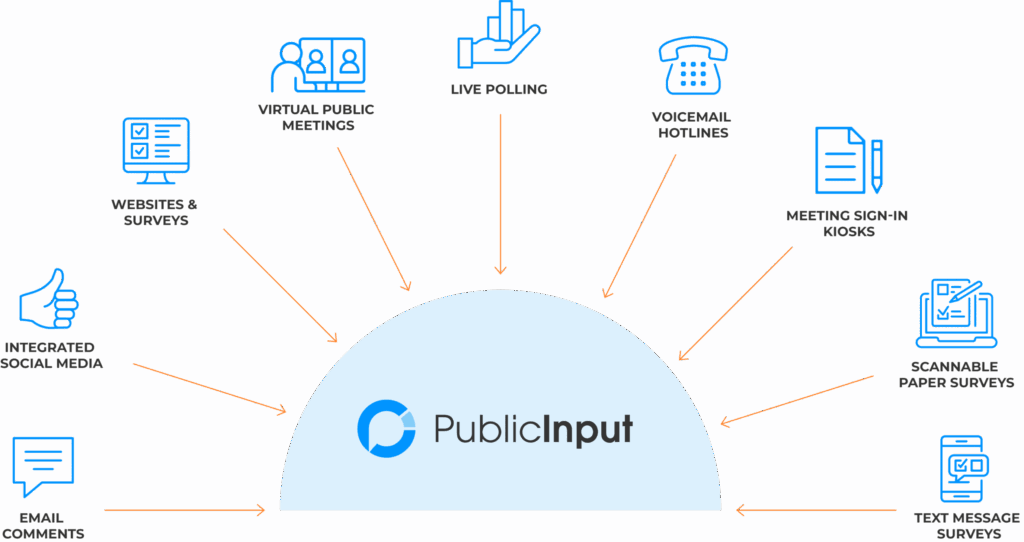
PublicInput centralizes every stage of the engagement process, from outreach to documentation, in a single platform built for government.
Choosing the Right Platform
Not every platform marketed to government agencies is actually built for government. It’s worth asking a few grounding questions before evaluating options.
- Workflow Integration: Does it handle your full engagement workflow, or just one piece of it? A meeting tool that doesn’t connect to your survey data isn’t a platform. It’s another tab.
- Government-Ready Compliance: Is it designed around government compliance requirements, or adapted from a business product? The compliance surface for government engagement, including ADA, Title VI, FOIA, and public notice standards, is specific. It shouldn’t be an afterthought.
- Inclusive Reach: Can it reach residents who aren’t online? If not, the participation data it produces will have a structural gap that no amount of reporting can fix.
- Defensible Records: Will it produce documentation you’d be comfortable handing to a lawyer, a regulator, or a journalist? If there’s any hesitation, that’s the answer.
For agencies evaluating their options, community engagement plans built around these requirements offer a useful starting point for understanding what a full-platform approach looks like in practice.
The System Makes the Difference
Agencies that do community engagement well aren’t necessarily the ones with the most resources. They’re the ones with a process that doesn’t depend on individual heroics to hold together.
The right software doesn’t make engagement easy. Public engagement is genuinely complex, and no platform changes that. What it does is make the complexity manageable, the records defensible, and the outcomes more equitable.
If your agency is managing public engagement across disconnected tools, there’s a better way to work. See how community engagement software built for government can simplify the process from outreach to documentation.