Multilingual & Accessible Public Engagement Tools for Government Agencies

Accessibility and language access have always been part of what government engagement is supposed to do. Most agencies are committed to both. The challenge is that commitment and infrastructure are two different things. Some agencies have multilingual and accessible participation built into every engagement touchpoint: surveys, meetings, outreach, and reporting. Others are still managing it reactively, adding captioning at the last minute, translating documents manually, fielding accommodation requests one at a time.
The gap between the two isn’t a difference in values. It’s a difference in tools. Online and offline resident outreach built for government is designed to make inclusive participation systematic rather than reactive, so accessibility and language access are present from the start, not added under pressure.
What Are Multilingual & Accessible Public Engagement Tools?
Multilingual and accessible public engagement tools are a connected set of platform capabilities that determine who can participate in government engagement and on what terms.
The two dimensions are distinct but inseparable. Multilingual tools address language access: the ability for residents who don’t speak English as a primary language to receive information, engage with content, and provide input in a language that works for them. Accessible tools address disability access: the ability for residents with visual, auditory, cognitive, or mobility-related disabilities to participate fully using the tools and formats that work for them.
Together they answer the same foundational question: can every resident participate meaningfully, regardless of language or ability? When the answer is yes, participation is genuinely inclusive. When it isn’t, participation data reflects who could easily engage, not who is actually affected.
Public engagement practitioners across communications and planning lead this work at agencies of all types, in partnership with ADA Coordinators, Equity Officers, and Title VI Officers who ensure accessibility and inclusion responsibilities are met. That includes state Departments of Transportation, regional Metropolitan Planning Organizations, local transit agencies, and local government teams, all of whom operate under federal frameworks that make accessible and multilingual participation a documented requirement, not just a goal.
Where General Tools Fall Short
General engagement platforms and consumer tools weren’t designed with accessibility and language access as core requirements. The gaps show up in three consistent patterns.
Reactive accommodation. When accessibility isn’t built into the workflow, it becomes a series of individual coordination tasks. Captioning requested separately for each meeting. Translation handled manually for each document. Each accommodation is a new conversation. Staff spend significant time managing the logistics of inclusion rather than the substance of engagement.
Inconsistent language access. Machine translation layered onto tools not designed for multilingual use produces inconsistent results. Key interface elements may not be translated. Outreach notifications arrive only in English. Residents who submit input in another language may receive responses or updates they can’t understand. The experience of engagement varies significantly depending on what language a resident speaks.
Participation isn’t equal. Some tools technically allow participation but don’t provide equal experience. A phone line that works differently from video. A survey that isn’t navigable with a screen reader. A public meeting where remote participants can hear but can’t fully engage. Participation without equal access isn’t inclusive engagement. It’s the appearance of it.
Accessibility built in and accessibility bolted on produce fundamentally different outcomes. One makes inclusion the default. The other makes it the exception.
What Built-In Accessibility & Language Access Covers
A platform designed for multilingual and accessible engagement handles these requirements as part of the standard workflow, not as accommodations added afterward.
WCAG 2.2 compliance: Covers all engagement touchpoints, including project portals, surveys, meeting interfaces, and outreach tools. Residents using assistive technology encounter a consistent, accessible experience regardless of which part of the engagement process they’re interacting with.
Real-time multilingual captioning and transcription in public meetings is accurate enough to be genuinely useful, not just technically present. Residents with hearing impairments and those joining by phone can follow proceedings and participate on equal terms with in-person attendees. Accessible public meeting management tools extend this to the full meeting lifecycle, from registration and participation to the post-meeting record.
Screen reader compatibility means full participation for residents with visual impairments. Not partial access. Not a workaround. The same surveys, portals, and comment forms that other residents use, accessible through the tools they rely on.
Multilingual survey and portal interfaces allow residents to engage in their primary language without requiring staff to create separate translated versions of each project page. The interface adapts on-demand. The content is accessible. Residents don’t need to translate their own participation.
In-language outreach extends multilingual capability to the front end of engagement: SMS, email, and notifications delivered in a resident’s preferred language, so the invitation to participate is as accessible as the participation itself.
Phone-based participation provides a full participation channel for residents without digital access, without comfort using online tools, or without access to language-appropriate digital interfaces. For many residents, the phone is not a fallback. It is the channel.
Equity Mapping identifies which language communities and residents with disabilities haven’t been reached, so agencies can adjust outreach before a comment period closes rather than after the data is already incomplete.
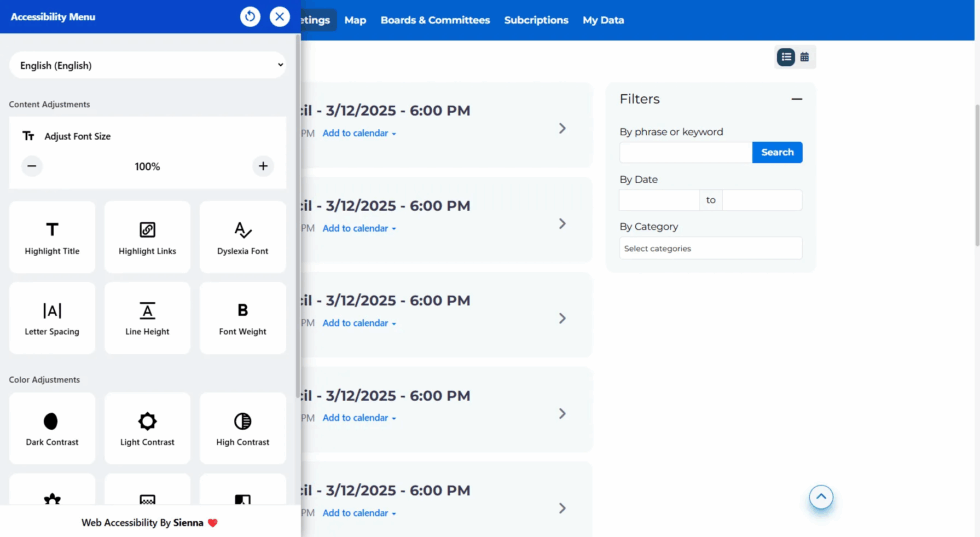
PublicInput’s multilingual and accessibility tools bring language access and ADA-compliant participation into every engagement touchpoint, from outreach to meeting management.
The Legal and Equity Framework
Accessibility and language access in government engagement aren’t best practices. For most agencies, they’re legal obligations.
The Americans with Disabilities Act and Section 508 of the Rehabilitation Act establish digital accessibility requirements for government agencies and federally funded programs. WCAG 2.2 is the technical standard that defines what accessible means in practice. These requirements apply to digital engagement tools, not just physical spaces.
Title VI of the Civil Rights Act prohibits discrimination by agencies receiving federal funding. For public engagement, that means agencies must provide meaningful access for communities where residents have limited English proficiency. The federal Limited English Proficiency guidelines give specific direction on what that access requires and how agencies should document their efforts.
The two frameworks reinforce each other. ADA and Section 508 define accessibility for residents with disabilities. Title VI and the LEP guidelines define language access for residents with limited English proficiency. Together they define the full scope of inclusive participation that government agencies are obligated to provide.
Meeting these requirements reactively, one accommodation at a time, is both operationally inefficient and legally insufficient. The record needs to show that access was designed in, not added on.
Who Needs Dedicated Multilingual & Accessible Tools
The clearest indicator is any agency with a community that doesn’t fit the default assumptions built into general engagement platforms.
Agencies with significant LEP populations: Title VI requires documented language access efforts. An agency that can’t show its outreach was available in the languages its community speaks has a compliance gap regardless of how many responses it collected.
Transit agencies, MPOs, and DOTs: Federal funding creates specific equity and accessibility obligations that go beyond state and local requirements. The compliance bar is higher, the documentation standard is more rigorous, and the consequences of gaps are more direct.
Agencies running hybrid or virtual meetings: ADA requirements extend to digital participation. A hybrid meeting where captioning is inadequate, phone access is a workaround, or the interface isn’t screen reader compatible doesn’t meet the standard.
Agencies managing multichannel engagement: When accessibility and language access vary across channels, residents encounter an inconsistent experience depending on how they choose to participate. Consistent compliance requires consistent tools, and that means local government engagement teams managing engagement across multiple touchpoints need a platform where those standards are built into every channel.
Inclusion That Holds Up
Agencies committed to inclusive engagement are doing the right work. The question is whether their tools make it possible to do that work consistently and produce a record that reflects it.
Reactive accommodation is expensive in staff time and inconsistent in outcomes. Built-in accessibility and language access change the default, so every project, every meeting, and every outreach effort starts from a foundation of inclusion rather than building toward it.See how online and offline resident outreach built for government makes multilingual and accessible engagement a consistent feature of every project rather than a coordination task for every team.