A Practical Guide to Language Accessibility in Public Engagement
For state and local governments, meeting language access responsibilities is more than a legal requirement. It is a measure of whether your engagement process actually reaches the community it is meant to serve.
According to the U.S. Census Bureau, a significant share of people in the United States speak a language other than English at home, with Spanish representing the largest portion of that population, followed by a range of Asian, Pacific Islander, and other Indo-European languages.
For government agencies, this is not background context. It is the operating environment.
Developing and implementing an effective language assistance program is both necessary and, for many agencies, required. The challenge is that doing it well is genuinely complicated, time-consuming, and often resource-intensive. This guide is a starting point for practitioners working through that challenge.
The Federal Compliance Framework
Language accessibility in public engagement is governed primarily by Executive Order 13166, which requires federal agencies and recipients of federal funding to ensure meaningful access for people with Limited English Proficiency (LEP). For state and local agencies, this obligation is frequently tied directly to federal funding compliance.
LEP plans are not optional for federally funded agencies. They are a condition of the funding itself.
Each LEP plan is developed by analyzing the proportion of people experiencing linguistic isolation in the community and incorporates a concrete plan to ensure those identified have meaningful access to federally funded programs and activities. Plans are typically developed using US Census data and updated on a regular cycle as community demographics shift.
The four-factor analysis that guides most LEP plan development asks agencies to assess the number and proportion of LEP individuals in the service area, the frequency with which those individuals come into contact with the program, the importance of the program to LEP individuals, and the resources available to the agency.
Practical Resources for Language Accessibility Planning
The responsibility of developing language accessibility plans can feel daunting. Several publicly available resources help practitioners move from obligation to implementation.
- Translation Guides: The Top 10 Best Practices for Multilingual Websites provides a practical starting point for agencies working to make digital engagement materials accessible across languages.
- I Speak Cards: Developed through the National Register of Public Service Interpreters, these cards allow residents to identify their language quickly and without requiring staff to guess, particularly useful at in-person events and meeting sign-in points.
- National Language Service Corps: A congressionally authorized Department of Defense program that provides language and cultural support to US Government agencies. A useful resource for agencies working on complex or high-stakes engagement initiatives that require professional interpretation.
Lowering language barriers to participation also means building these resources into standard workflow, not treating them as exceptions to be arranged on a case-by-case basis.
Language Accessibility in Public Meetings
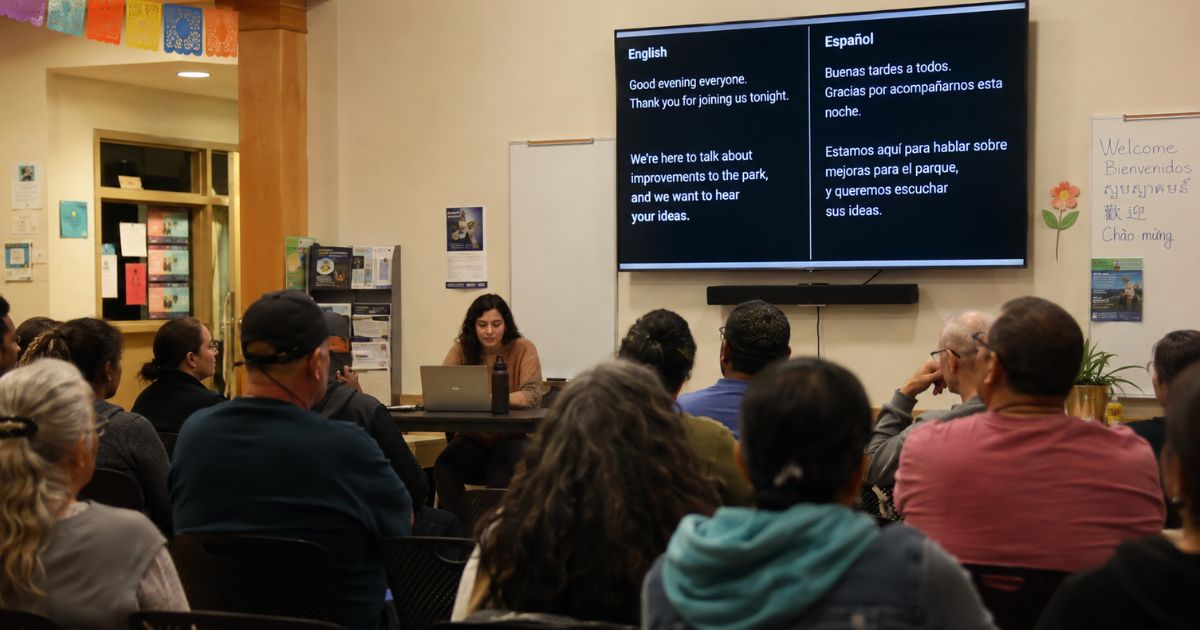
A new standard for public meetings has emerged. Residents and community members increasingly expect practical, accessible language options as a baseline, not as a special accommodation. Accessible public meeting management built for government accounts for this reality from the outset rather than retrofitting accommodations after the fact.
For agencies evaluating their current meeting practice, a few questions are worth working through:
- Real-Time Language Support: Do your public meetings support a broad array of real-time, on-demand language options? Or does language support require advance arrangement with no guarantee of coverage?
- Translation Turnaround: Can meeting minutes and records be transcribed and translated in a timely manner after the meeting closes? Or does translation represent a significant delay in the availability of the public record?
- Process vs. People: Does your current language support process prioritize the needs of residents, or does it prioritize internal process efficiency? A requirement that residents request interpretation seven days in advance is a process efficiency measure, not a language accessibility measure.
Purpose-built online and offline resident outreach tools address these gaps by building language support into the engagement process itself, rather than treating it as a separate coordination task.
How Technology Closes the Gap
PublicInput’s Multilingual Closed Captioning for virtual public meetings was built specifically to address the limitations of general tele-conferencing platforms. It supports over 108 languages, does not require a live interpreter to transcribe, eliminates per-meeting setup delays and special licensing fees, and supports multiple languages simultaneously without separate streams.
Language access shouldn’t require an advance request. It should be on by default.
After a meeting adjourns, the platform closes the loop with a transparent process that integrates with any language accessibility plan. Smart transcription capabilities allow agencies to replay the full transcript or comments, translate into multiple languages, save centrally for archiving, download transcripts and audio, share transcript links and files, and edit transcripts and speaker labels.
When government survey and project tools are built with language accessibility in mind from the beginning, agencies spend less time managing the logistics of translation and more time using the input they receive.
If your agency is managing language access through a patchwork of manual arrangements and separate tools, there is a more integrated way to meet the obligation. Explore how community engagement software built for government supports language accessibility across meetings, surveys, and outreach in a single platform.