
How Charleston County Freed Up Staff Time While Growing Positive Feedback 8x

Charleston County, SC is home to about 415,000 residents across more than 1,350 square miles of urban, suburban, and rural communities, with about 35% of residents identifying as a minority. When the County’s Zoning & Planning Department set out to modernize how residents weigh in on rezoning decisions, a process the County was later recognized for with the Resourceful Innovator Award, it ran into a challenge familiar to almost every local planning team: the volume of feedback had outgrown the manual process built to handle it.
A Fragmented, Labor-Intensive Process
Before PublicInput, staff manually sorted hundreds of comments from emails, paper letters, petitions, and voicemails. Preparing materials for the nine-member council meant printing massive binders and constantly updating them as new feedback arrived. Project Officer Niki Grimball described it this way:
“A very daunting task to keep up with. Did I print it? Did I not print it? Did I convert it to a PDF? I don’t know.”
The effort required to participate meant feedback skewed toward residents with strong objections or a financial stake, while busy supporters rarely weighed in, leaving staff stretched thin and decision-makers with an incomplete picture.
One Platform for Every Channel
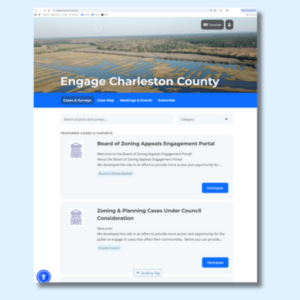
Charleston County centralized every channel of feedback, online, voicemail, email, and text, into one project record instead of several. Grimball said everything can be handled within the platform: staff can look through all the emails coming in and tag them, and the same goes for text messages and voicemails. Having all of these different options, and pulling it all together in the same format, has been a real asset for the team. Setting up that structure for a new project, a unique phone number, text code, QR code, and email address, now takes about five minutes:
“Setting up a project page and getting all of the QR code, the text, and the phone number set up takes me about five minutes total for a new project, so it’s really simple and intuitive to set up.”
Residents get a say in how they stay involved, too. As Grimball put it, residents now have full control over which lists they’re subscribed to. They can join or drop off as often as they’d like, and that flexibility is built directly into the page.
Faster Reporting, Broader Participation, More Trust
The clearest change showed up in reporting. What used to mean manually updating documents and reprinting binders for the council became, in Grimball’s words, a live document:
“We are not manually adding these comments and updating it for the decision makers, and reprinting things and hoping that our count is up to date. Whenever that person goes to click on the link, then it’s all up to date right there for them.”
That shift freed staff to focus on outreach instead of paperwork, and it changed who showed up in the record: positive feedback rose from 1 to 2% of comments to 16%, as voicemails, text surveys, and online portals brought in residents who never would have shown up to a meeting or mailed in a letter. Real-time geospatial mapping and demographic filtering gave decision-makers a clear view of who was participating and where, and a permanent project archive kept the process transparent long after each comment period closed.
Why This Matters Beyond Rezoning
For a planning or zoning department managing land use decisions in front of a council, a commission, or any body that needs a defensible public record, Charleston County’s rezoning process is a case study in what happens when reporting stops being manual: residents get more ways to participate, staff get time back, and decision-makers get a link that’s always current.
See how PublicInput can support your department’s engagement and reporting.