
Asheville Transit Found $10,000 in Savings by Simplifying Rider Communications
Finding more value in the tools the team already had
When ART (Asheville Rides Transit) looked at its rider alert program, the opportunity wasn’t to add another communication tool. It was to eliminate one.
The transportation team had been using a separate software to send iRide rider alert emails while already using PublicInput for project-based communications. Maintaining separate systems meant another subscription, another subscriber list, and another workflow for staff to manage.
So the team moved its rider alert emails into PublicInput.
The change saved ART nearly $10,000 a year, reduced manual work for staff, and gave the team a simpler way to manage rider communications alongside its broader community engagement work.
The best solution was already in use
The City’s previous email software no longer aligned as well with the team’s evolving needs.
Maintaining a separate system was expensive, limited the number of administrators, and didn’t integrate with the systems their organization was already using. Staff also had to manually create and insert translations for Spanish, Russian, and Ukrainian alerts, adding time to a process where speed matters.
At the same time, the City was already consolidating subscriber lists and project pages in PublicInput.
“We wanted to streamline our current process to something that was more suited to our needs and user-friendly,” said Jessica Hughes of Asheville. “Transportation was already using PublicInput for our project-based comms so it only made sense.”
With the foundation already in place, the team saw an opportunity to simplify the process without adding another platform to manage. It was about recognizing that Asheville was paying for functionality in one platform that it could already support through another.
A one-day migration with little disruption
The transition was much simpler than a major system change might suggest.
The team exported its existing subscriber list as a CSV and uploaded it directly into PublicInput. They also updated the website and QR-code links used to sign people up for iRide alerts.
The migration took roughly a day, and the team timed the changes around its first alert send. At the time, the list included approximately 800 to 900 subscribers.
For riders, the change was largely invisible.
“The community hasn’t really noticed the difference because if you’re going to subscribe, you just go to the link,” Jessica said.
That was important to the transportation team. The goal wasn’t to make riders learn a new system. It was to make the work behind the scenes simpler while keeping the public-facing experience familiar.
Today, the iRide alerts list has grown to more than 1,000 subscribers.
The savings were only part of the improvement
Transportation had been spending nearly $10,000 a year on email communications to subscribers. By moving those notifications into PublicInput, Asheville was able to eliminate that expense and redirect the savings back into ART.
But the operational improvements may be just as meaningful.
Staff no longer have to manually translate each alert before sending it. Riders can translate emails as needed, which has also helped the team get information out faster. The emails have a more consistent, professional format, and the team gained additional reporting capabilities to support its communications.
PublicInput’s built in email templates also made it easier for staff to create consistent communications without starting from scratch each time.
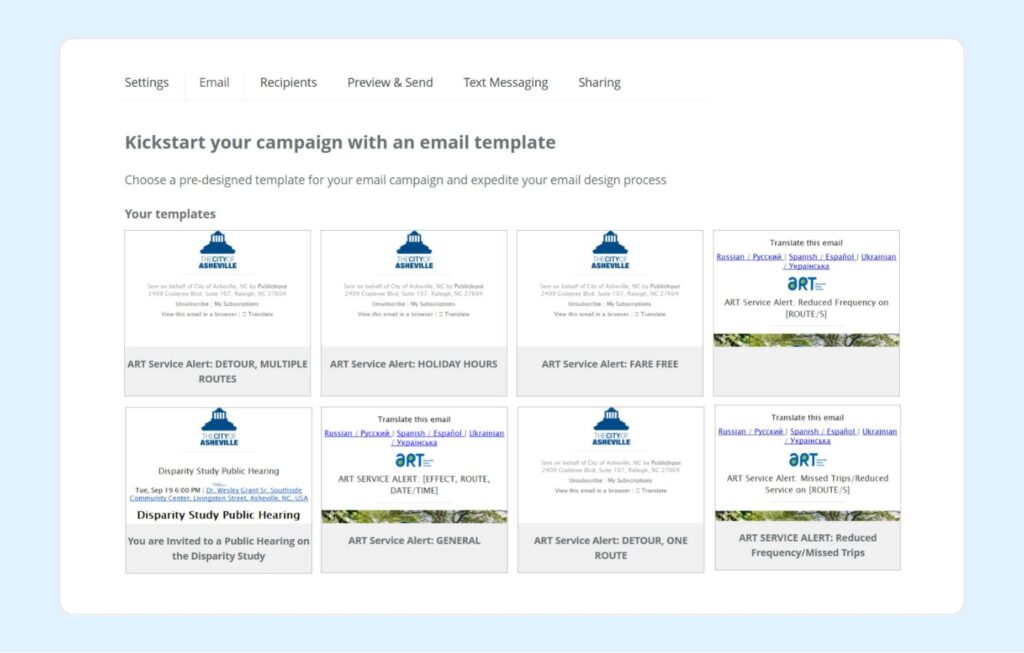
PublicInput’s email templates provide a simple starting point, helping staff build communications faster while still giving them flexibility to customize the content and design.
There was a short learning curve as staff learned the new workflow, but a brief training and step-by-step guide helped make the transition straightforward.
One subscriber list became useful beyond alerts
The move also created an unexpected benefit: the rider alert subscriber list could support other transportation communications.
As ART works through an assessment of its transit system and how well existing funding is serving the community, the team was able to use its existing subscriber list to expand outreach for that project.
That connection is part of what made the consolidation worthwhile. The list wasn’t just a place to store people who wanted service alerts. It became another resource the transportation team could use when it needed to reach people already connected to transit.
Consolidation doesn’t have to be all or nothing
Asheville’s experience also illustrates that simplifying technology doesn’t have to happen all at once.
The team started with the communication channel where there was a clear opportunity to reduce costs and simplify the work. From there, the same approach could be applied more broadly as needs and circumstances evolve.
For other agencies, the takeaway is practical: look at the tools you’re already using, identify where consolidation can make the biggest difference, and build from there. A simpler technology environment doesn’t have to mean replacing everything at once. It can start with one workflow that makes everyday work easier.
A simpler approach can go further
For Asheville, the benefits extended beyond eliminating a software expense. The team was able to reduce manual work, make rider communications more consistent, and put an existing subscriber list to work for broader transportation outreach.
“We were already consolidating all our other subscriber lists and project pages into PublicInput anyways,” Jessica said. “It definitely made things easier.”
The team also recommends making use of templates. They reduce the guesswork involved in creating communications and make it easier to train new staff.
For ART, a relatively simple system change delivered meaningful annual savings, reduced manual work, and made an existing subscriber list more useful for reaching the community.