

What you need to know about SB 707
The law mandates a new level of equity, accessibility, and technical redundancy. Agencies must now provide accessible, translatable agendas, offer robust two-way telephone and video access, ensure comment parity between in-person and remote speakers, and proactively engage non-English-speaking communities.
PublicInput has broken down each aspect of the new requirements to deliver turnkey compliance for California public agencies.
1. Hybrid Meetings Become the New Standard
The era of in-person-only meetings is ending for many public bodies. The core change introduced by SB 707 is the mandate for “eligible legislative bodies” to offer a hybrid meeting model.
These eligible bodies must provide the public with an opportunity to attend and participate via a two-way telephonic service or a two-way audiovisual platform. This means the public must be able to listen and offer public comment remotely.
The mandate also includes a disruption policy – to protect public access, agencies must adopt a formal policy for technology disruptions. If a service interruption prevents the public from attending a meeting, the body must recess and attempt to restore service for at least one hour before proceeding.
2. Expanding Language and Digital Access
SB 707 mandates specific outreach and translation efforts to promote truly diverse public participation. If 20% or more of the local population speaks a language other than English and isn’t fluent, the legislative body is required to provide translations of the meeting agenda and participation instructions in that language.
Agencies are also required to maintain an accessible, dedicated internet webpage detailing public meetings and outlining participation methods, which must also be translated into applicable languages.
In addition to expanding language access, the bill also includes mandates to proactively engage non-English-speaking communities. The law requires agencies to make reasonable efforts to invite groups that do not traditionally participate in public meetings, including outreach to organizations serving these populations
3. Teleconferencing for Officials and Board Members
While the new rules prioritize public access, SB 707 also adjusts the rules for legislative body members (officials) participating remotely. This includes the extension of “just cause” remote participation, extending the temporary ruling allowing board members to participate remotely for specific “just cause” reasons, such caregiving, illness, or military service, until December 31, 2029. Additionally, the bill formally recognizes a legislative body member’s right to participate by teleconference as a reasonable accommodation for a disability.
Lastly, the law enforces the legislative body’s authority to remote or limit participation from individuals to engage in disruptive behavior, whether they are attending in-person or remotely.
Is your agency an “Eligible Legislative Body”?
At a high-level, an eligible legislative body includes city councils and county boards of supervisors for jurisdictions with a population of 30,000 or more. It’s important to note that the law also applies to cities located in a county with a population of 600,000 or more – so even if the population of a city is less than 30,000, there is still a requirement to comply if the city is located in one of the 15 largest counties in California.
For Special Districts, the criteria is a little more complex. An eligible legislative body is defined as a district that meets one or more of the following criteria (starting in 2026, with annual adjustments):
-
- Annual operating revenues exceeding $400 million
- Full-time equivalent employee headcount exceeding 1,000
- The boundaries of the special district include a population of 200,000 or more
What should I do to prepare for SB 707?
If you’ve determined that SB707 does apply to your agency, meeting these complex requirements demands a purpose-built solution. PublicInput Board Meetings is a complete toolkit designed to help agencies streamline the entire meeting lifecycle and, specifically, to meet the exacting standards of SB 707.
Here’s how PublicInput’s features directly address the law’s key mandates.
1. Accessible, Translatable Public Portals & Agendas
SB 707 Requirement: Agencies must maintain an accessible internet webpage for public meetings, with explanations of procedures and a meeting calendar. This webpage, along with agendas, must be translated if 20% of the population has limited English proficiency. Agendas must also be posted in a machine-readable, searchable, and downloadable format.
PublicInput’s Solution: PublicInput provides a branded, accessible “Public Engagement Hub” that serves as your agency’s central, ADA-compliant meeting portal.
-
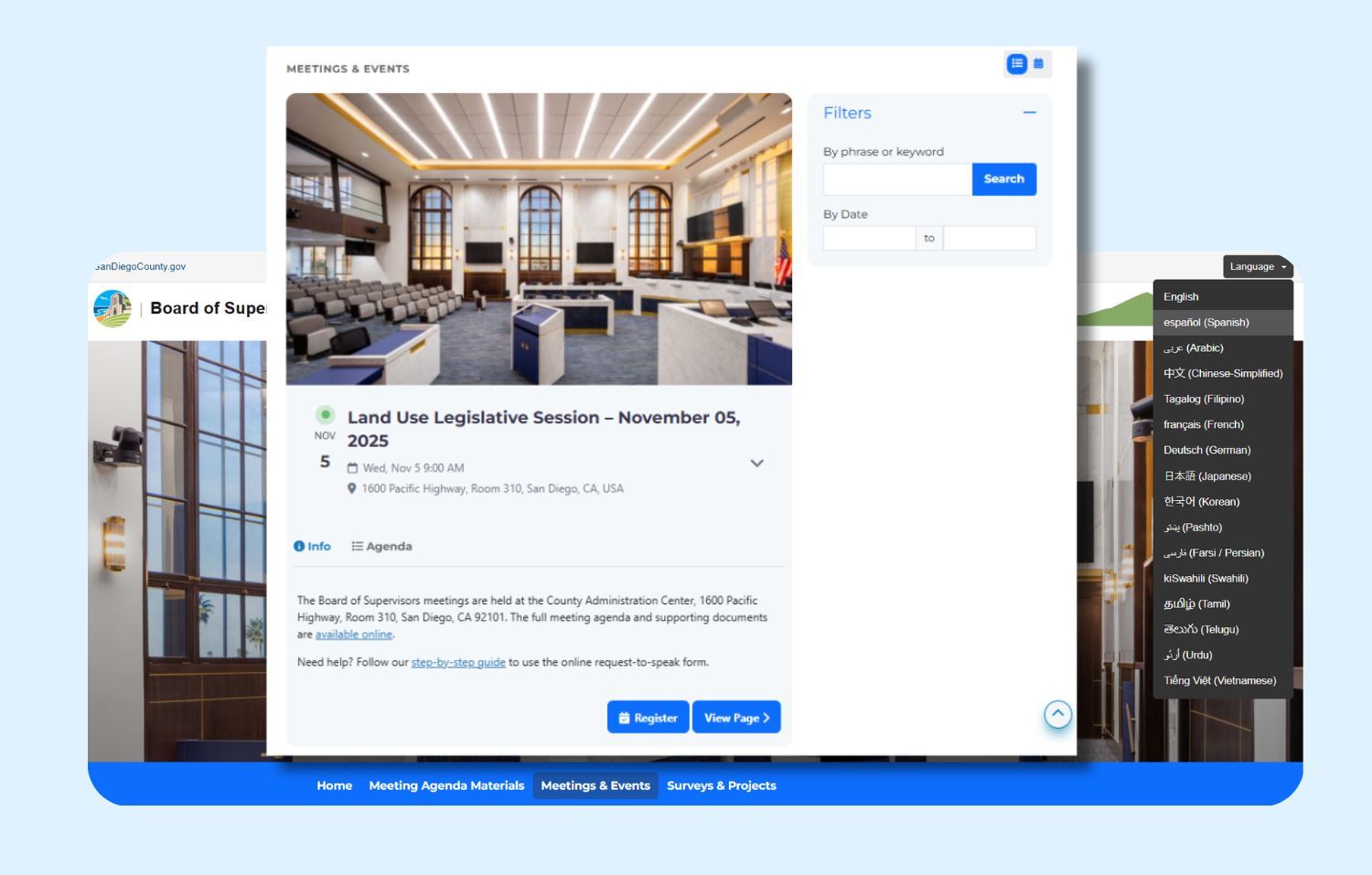
- One-Click Translation: The entire public portal, including agendas, can be translated into over 100 languages, helping you meet the LEP threshold requirement.
- Compliant Publishing: The platform integrates with existing agenda software like Legistar/OneMeeting to publish agendas that are machine-readable and ADA-accessible.
- Easy Navigation: The hub includes a public calendar and clear explanations of participation procedures, as seen in use by clients like San Diego County.
2. Robust Hybrid Access: Telephone and Video Redundancy
SB 707 Requirement: Agencies must provide a two-way telephonic service or a two-way audiovisual platform for the public to attend. Crucially, if an audiovisual platform (like a video stream) is used, the agency must also provide a call-in option and activate automatic captioning. The law also requires agencies to recess for technical failures and attempt to restore service.
PublicInput’s Solution: PublicInput is built for hybrid access and redundancy, moving beyond the limitations of a single video-conferencing tool.
-
- Built-in Hybrid Access:The platform automatically provides toll-free dial-in numbers and instructions for every meeting, ensuring compliance when you live-stream.
- Live Captions & Translation: The system generates live, automatic captions to meet accessibility requirements. These captions can also be translated in real-time, further breaking down language barriers.
- Built-in Redundancy: To protect against technical failures, PublicInput creates separate, concurrent phone and video livestream feeds. If the video stream fails, the phone line remains active (and vice-versa), ensuring continuity and reducing the risk of a mandated recess.
3. Equitable, Real-Time Comment Procedures
SB 707 Requirement: The law demands parity. Remote commenters must be given the same time allotment as in-person speakers. Agencies also cannot require comments to be submitted in advance and must provide an opportunity for the public to comment in real-time.
PublicInput’s Solution: This is a core function of the PublicInput speaker management dashboard. The platform was designed to manage complex, high-volume hybrid testimony.
-
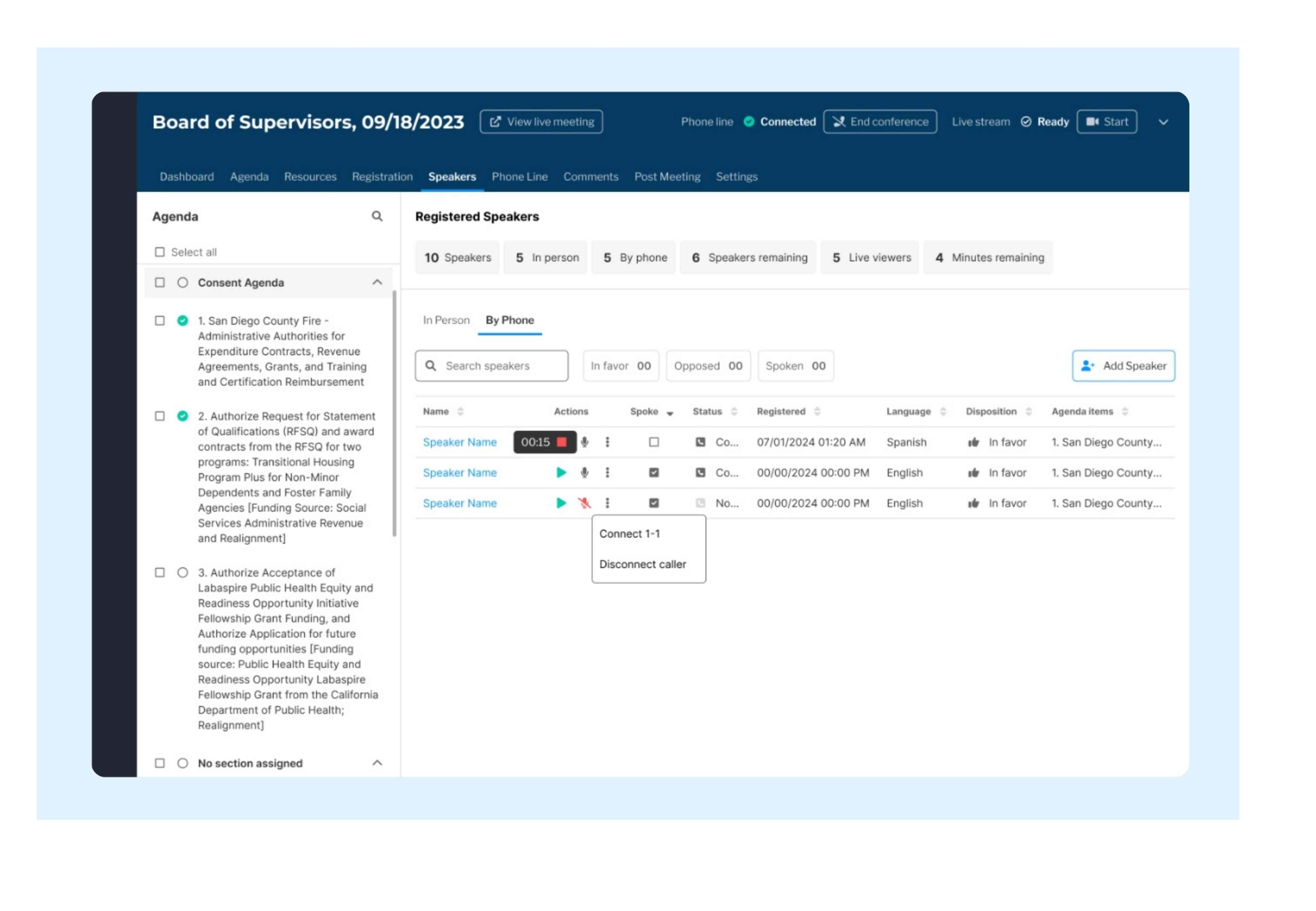
- Unified Speaker Queue: Staff manage a single dashboard that tracks all participants, whether they are in-person, virtual, or on the phone.
- Equitable Time Management: The system allows clerks to set identical time presets for both phone and in-person speakers, ensuring comment parity.
- Real-Time Comment Intake: Residents can register to speak online before the meeting or sign up in-person via a kiosk or QR code. Most importantly, staff can open and close the speaker queue for each agenda item live during the meeting, fulfilling the “real-time comment” mandate.
- Advanced Speaker Management: The dashboard allows staff to track who has spoken, manage the queue, and even huddle with callers before they go live.
4. Proactive and Inclusive Outreach
SB 707 Requirement: Agencies must make “reasonable efforts” to invite and engage groups that do not traditionally participate, including non-English-speaking communities.
PublicInput’s Solution: PublicInput is more than just a meeting management tool; it’s a comprehensive engagement platform. It includes targeted outreach tools to help agencies actively meet this requirement, such as multi-lingual email campaigns and the CBO (Community-Based Organization) network. The CBO Network provides a listing of registered community organizations operating in a given area, providing a basis for a more comprehensive distribution list for public notice.
Compliance at a glance
PublicInput has taken care to address each requirement of SB 707 and the Brown Act with an easy, turnkey solution.
| SB 707 Requirement | Relevant Bill Text | How PublicInput Satisfies |
| Public meetings portal (webpage) with translation | “Create and maintain an accessible internet webpage dedicated to public meetings … explanation of process; procedures; calendar.” “The accessible internet webpage … shall be translated into all applicable languages … §54953.4(b)(3)(B)(i)–(ii) and (c)(1)(B) |
Public Engagement Hub: branded, accessible meeting portal with calendar, process explainer, agenda/packet links, translatable into 100+ languages. |
| Translated agendas (20% LEP threshold) | “The agenda for each meeting … shall be translated into all applicable languages … ‘Applicable languages’ = ≥20% of applicable population and ≥20% of that group speaks English < “very well.” §54953.4(c)(1)(A); (d)(1) | Translated digital agendas: Synchronized from Legistar, digital agendas can be translated into 100+ languages. |
| Agenda posting & web standards | “Post agenda at least 72 hours in advance … on the agency website … provide alternative formats on request; online postings must be retrievable, downloadable, searchable, machine‑readable, and unrestricted.” §54954.2(a)(1), (a)(1)(B)–(C)(i)–(ii), (a)(2)(A)–(B) | Compliant publishing: one‑click publish from Legistar/OneMeeting sync. Machine‑readable, ADA accessible HTML agendas. |
| Hybrid public access | “All open and public meetings shall include an opportunity for members of the public to attend via a two-way telephonic service or a two-way audiovisual platform …” §54953.4(b)(1)(A)(i)(I)(ia) | Built-in hybrid access: toll‑free dial‑in and browser‑based participation. Managed queue for in‑person and virtual attendees. |
| Captioning if AV provided; call‑in option | “… if [the body] provides a two‑way audiovisual platform, [it] shall publicly post and provide a call‑in option, and activate any automatic captioning function …” §54953.4(b)(1)(A)(ii) | Captions + call‑in: Live captions generated during the meeting with real-time translation. Automatically display Dial‑in numbers & instructions. |
| Pause for technical failure | “If a disruption prevents attendance/observation, [the body] shall recess for ≥1 hour and make good‑faith restoration attempts; if not restored, adopt a roll‑call finding …” §54953.4(b)(1)(A)(i)(I)(ib)–(Ic) | Built in redundancy: Creates separate, concurrent phone and video livestream feeds to ensure continuity. |
| Remote public comment parity | “… shall provide the public with an opportunity to provide public comment via the two‑way platform, and ensure the same time allotment as in‑person.” §54953.4(b)(1)(B)(i) | Equal‑time for speakers: identical time presets for phone and in‑person speakers |
| Real‑time comment during teleconference meetings | “Shall not require public comments to be submitted in advance … and must provide an opportunity to comment in real time.” §54953.8(b)(4) (+ timing in §54953.8(b)(6)) | Live comment intake: open/close queue per item. Accommodate live speakers in-person and remotely. |
| Outreach to underrepresented communities | “Make reasonable efforts to invite groups that do not traditionally participate … non‑English‑speaking communities and community organizations.” §54953.4(b)(3)(C) | Targeted outreach tools: multi-lingual email campaigns, CBO network, Caltrans data sharing. |
Beyond Compliance: Gaining Efficiency
Meeting SB 707’s requirements doesn’t have to mean more manual work for staff. PublicInput automates tasks across the entire meeting lifecycle.
- Before the Meeting: Staff get a pre-meeting dashboard showing a snapshot of registered speakers and estimated speaker time by agenda item, allowing for better time management. Automated email and text message reminders are sent to registered speakers to ensure they arrive prepared.
- After the Meeting: The system automatically generates detailed speaker reports and meeting transcripts. Clerks can then leverage AI-powered smart transcription tools to build draft minutes documents, saving hours of cross-referencing videos and notes.
SB 707 presents a significant challenge, but it’s also an opportunity to build public trust. PublicInput Meetings provides the integrated, modern toolkit agencies need to not only comply with the law but also to run more efficient, transparent, and accessible public meetings.
See it action. Book a demo to discover how PublicInput helps you run meetings more efficiently and ensure compliance with SB 707.