General CRMs vs. Government Resident Engagement Platforms

Local government agencies collect resident contact information across dozens of projects every year. Outreach lists exist. Email campaigns go out. Public comment is recorded. The question is not whether agencies are building contact databases. The question is whether those databases are organized in a way that lets agencies answer the questions leadership actually asks.
A contact list and a participation record are not the same thing.
Commercial CRM tools were built for sales pipeline tracking and B2B marketing workflows. Contact records in these systems center on deal stages, email sequences, and account hierarchies. They were not designed to track participation across multi-channel engagement initiatives, link residents to the specific projects they engaged on, or produce sociodemographic reports without exporting to external analytics tools. For government agencies trying to repurpose these platforms for resident engagement, the result is not a unified record. It is a continuous manual effort to connect data that the system was never structured to connect in the first place.
Where Commercial CRMs Fall Short for Government Engagement
Commercial CRMs organize contact records around a sales funnel. The data model asks: how close is this contact to converting? What stage of the buying process are they in? For a government communicator managing resident engagement, those are not the questions that matter.
The questions asked are: who participated in this initiative? Which neighborhoods were represented? Who did we reach and who did we miss? A commercial CRM struggles to answer those questions without significant custom configuration, manual data entry, and ongoing reconciliation work across tools.
Multi-channel participation tracking
Government engagement workflows require tracking participation across in-person meetings, SMS responses, phone-in comments, and online submissions. Commercial CRMs do not link participation across these channels to a single resident on their own. When a resident attends a public meeting in person, submits a comment online, and responds to an SMS survey about the same project, those three interactions are not tied together. The agency has to reconcile them manually, or work from a fragmented picture where one resident looks like three unrelated contacts.
Initiative-linked participation history
Purpose-built resident engagement platforms capture participation history linked to specific initiatives, meeting dates, and comment content. Commercial CRMs require custom object structures and manual data entry to approximate this. The difference is not small. In a commercial CRM, linking a contact to a specific public meeting, capturing what they said, and associating that comment with the agenda item they addressed requires building custom objects, training staff on data-entry protocols, and maintaining those protocols across projects. The system does not do this work by default because it was not designed for it.
Reporting sociodemographic representation
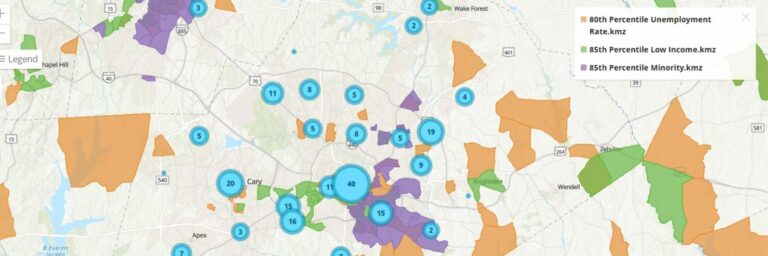
Demonstrating representative engagement requires data analysis that is representative of the community population, including participation by neighborhood, language preference, income level, or other sociodemographic dimensions. Commercial CRMs cannot produce these reports without exporting data to external analytics tools. The fields may exist in the CRM, but the ability to filter participation by initiative, compare representation across projects, or visualize geographic coverage gaps does not. Agencies end up exporting contact lists to spreadsheets, cross-referencing them with GIS data, and manually assembling the representation analysis.
What a Resident Engagement CRM Actually Does
A resident engagement CRM is a contact list organized by participation history, not a marketing database organized by funnel stage. The data model centers on who engaged on which initiative and when, not how close they are to making a purchase decision.
When an agency uses a purpose-built resident engagement platform, every contact record is tied to the initiatives that person participated in. The system tracks which meetings they attended, which surveys they responded to, which public comment periods they submitted input during. Participation arriving by SMS and phone feeds the same unified record natively, with no third-party integrations or custom development required. That history is not stored in a notes field or a custom object. It is the structure of the database itself.
This structure makes it possible to answer the questions government communicators are actually asked:
- Who participated: Who took part in this initiative, and who did not?
- Representation: Which neighborhoods were represented in the feedback?
- True reach: How many residents participated, and which of them engaged through more than one channel?
- Equity view: What does participation look like when filtered by language preference or income level?
When the same resident responds by text and again by email, the system attributes both interactions to that person. The agency can still see participation by resident, by neighborhood, and by project, so the picture of who actually engaged holds up without manual reconciliation. Because every interaction is attributed and structured, the platform automatically generates map-based participation reports and can segment participants by geography, demographics, project, and other engagement attributes, directly inside the same database that captured the input.
The commercial tool stack isn’t just inefficient. It’s a structural mismatch.
If an agency is running engagement across disconnected tools, the problem is not that the tools are weak. The problem is that they were built for different workflows. Consumer survey tools were built for one-time surveys. Commercial CRMs were built for sales pipeline tracking. Neither was designed to produce a unified participation record across multiple channels and multiple initiatives over time. Stitching them together manually does not change what they were designed to do.
When the Question Is Participation History, Not Pipeline Stage
Ask a commercial CRM how many residents participated in an initiative and which neighborhoods were represented, and it can return a contact count. It cannot return a participation breakdown by initiative, by channel, or by sociodemographic segment without significant manual work. That manual work is the entire value a system is supposed to provide.
A purpose-built resident engagement CRM answers those questions by design. Participation is captured across every channel in one record. Contacts are linked to initiatives. Representation reports are generated from the same database that captured the input. The question that was asked is the question the system was built to answer.
See how resident engagement CRM software built for government tracks participation history across initiatives, channels, and sociodemographic segments without manual reconciliation.