Why Traditional Public Meetings Exclude More Voices Than They Include
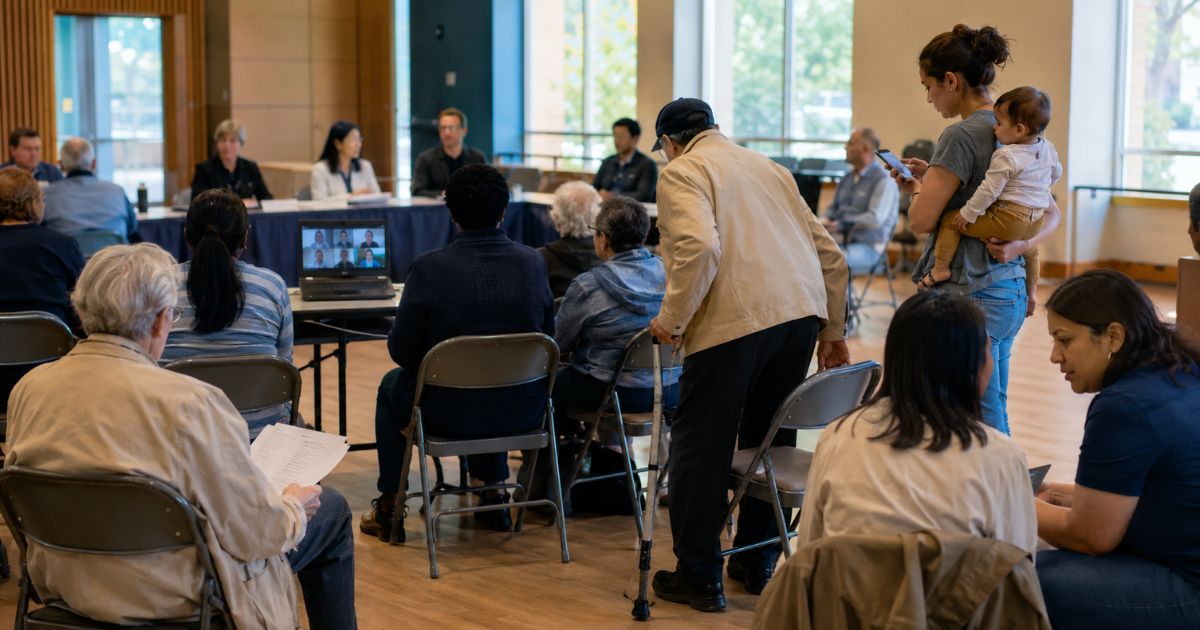
Most public meetings reach a narrow slice of the community, and the agencies running them already know it.
They’ve watched the same handful of residents speak at comment after comment. They’ve held the meeting at 6pm and noticed working parents missing. They’ve sent the notice in English and wondered who didn’t see it.
The traditional public meeting format was built for a smaller and less diverse civic process than the one agencies are running today: one place, one time, one language, one channel. Each is a participation gate. Together, they exclude more voices than they include.
Public meeting management software built for government is designed to work around those gates instead of assuming them.
What Traditional Meetings Actually Exclude
The traditional meeting format builds in three structural barriers that show up consistently across communities of any size.
| Barrier | What It Looks Like in Practice | Who’s Most Affected |
|---|---|---|
| Broadband / digital access | Hybrid meetings, online input forms, and video-only participation paths | Rural residents, low-income households, older adults |
| Language access | Meetings held in English; agendas, slides, and public notices not translated | Limited English proficiency communities, immigrant populations |
| Accessibility | Inconsistent captioning, no sign language interpretation, materials not screen-reader compatible | Residents with disabilities, deaf/hard-of-hearing, blind/low-vision residents |
The barriers compound. The same residents and the same neighborhoods sit at the intersection of two or three at once. A meeting held in English and online is exclusionary on two dimensions. A meeting that’s English-only, in-person, and held at 6pm is exclusionary on three.
Local government engagement teams see these barriers show up the same way across communities of any size. The next sections take each in turn, starting with the one hybrid meetings were supposed to solve.
Why Hybrid Meetings Don’t Close the Broadband Gap
Hybrid meetings were supposed to close the participation gap. By the time most agencies had built the infrastructure to run them, the expectation was that virtual access would remove time and place as constraints, and the room would finally widen.
It widened, but not the way the format suggested it would. Joining a meeting online requires reliable broadband, a device capable of running video, and enough digital comfort to navigate the platform. Each of those is unevenly distributed across the same communities most likely to be affected by what’s on the agenda.
Broadband adoption is consistently lower in rural counties than urban ones. It’s lower among older residents than younger ones, and lower in lower-income households where mobile-only access is more common. A two-hour public meeting on a 4-inch screen, with spotty LTE, no reliable way to raise a hand, no easy way to see who’s speaking or read shared documents, and the cognitive load of just staying connected, is access wearing participation as a costume. The platform supporting it shifts the burden onto the resident. Technically supporting participation and meaningfully enabling it are not the same thing.
What looks like wider access often reaches the same audience that already had access. The hybrid format adds a venue. It rarely adds a population.
Hybrid meetings are necessary infrastructure. Any agency running public meetings without remote participation today is leaving voices out by default. The challenge is that hybrid alone treats participation as a venue problem, and participation requires conditions the meeting can’t supply on its own: a broadband connection, a quiet room, a device, time during the workday or the evening, comfort with the platform. The meeting format can’t fix all of those. It can stop assuming them.
Hybrid meetings reach the people who already had access. The format widens the venue, not the audience.
Where Language and Accessibility Break Down in Meeting Format
These two barriers operate the same way. They’re built into the format, not the effort.
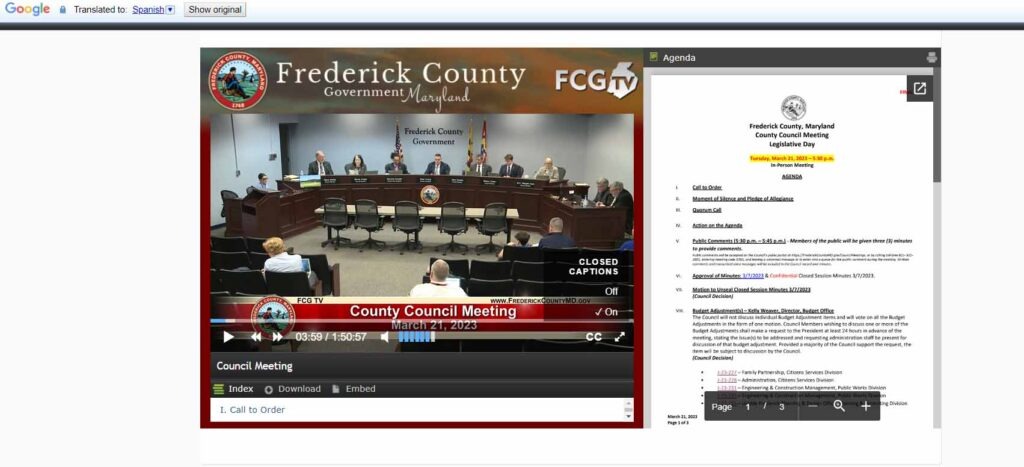
Language access in meetings rarely extends past the room. Most public meetings happen in English. Agendas, slides, and public notices are typically posted in English. Real-time interpretation is uncommon, and when it’s available, it usually requires a resident to identify themselves as needing an accommodation and request it ahead of time. Auto-captioning has improved, but most platforms generate captions only in the language being spoken. A Spanish-speaking resident watching the recording finds the captions are also in English.
Accessibility tends to be evaluated tool by tool, not end to end. Video platforms vary in caption quality. Meeting recordings often lack accurate captions or transcripts. Sign language interpretation is rare and costly. Materials posted online may not pass Web Content Accessibility Guideline (WCAG is the federal standard for digital accessibility) checks. Mobility access at physical venues is uneven. A meeting that’s accessible in one dimension can fail in another, and the resident affected by that failure has no way to participate at all.
Each of these is a known issue. None is impossible to address with the right infrastructure. The challenge is that traditional meeting tools were designed to run a single meeting in a single language for a single audience. Inclusive participation requires more than the format alone can do.
What Inclusive Meeting Infrastructure Looks Like
Inclusive meeting infrastructure starts with the assumption that participation will happen across formats, languages, and ability profiles. The process is built to accommodate that from the start.
A meeting designed for inclusion has multiple synchronous and asynchronous channels available. Residents can attend in person, join by video, dial in by phone, or submit comments through SMS or written input before, during, or after the meeting. The meeting record captures all of them as part of the same participation event.
Accessible public meeting management makes inclusion the default rather than the exception. Captions are generated automatically across in-person, virtual, and hybrid formats. Materials are screen-reader compatible. Meeting recordings come with accurate transcripts, not just timestamped video.
The accessibility surface a resident encounters is the same whether they joined the room, the video feed, or the phone bridge. Multilingual access is built for the resident, not assumed by the platform. During a meeting, residents choose their preferred language for live closed captions. On project pages and meeting pages, the same self-service control shifts the full content into the language they read. The platform supports the choice; the resident makes it.
Online and offline resident outreach reaches the residents who can’t attend regardless of channel. SMS reminders, phone outreach, and custom QR codes on in-person flyers at libraries and transit stations turn the meeting into part of a broader engagement effort instead of the only access point.
Inclusion is structural. It comes from removing gates the format builds in.
The Question to Ask Before the Next Meeting
The agencies running inclusive meetings are asking a different question than the one they used to ask. The old question was: did we hold the meeting? The new question is: did we hear from the people the meeting was for?
If the meeting reached the same handful of residents who always show up, the format is still doing what it was designed to do. It will keep doing that until something about the format changes.See how public meeting management software built for government is designed to widen the audience, not just the venue.