
Why Disjointed Public Engagement Tools Create Compliance Risk

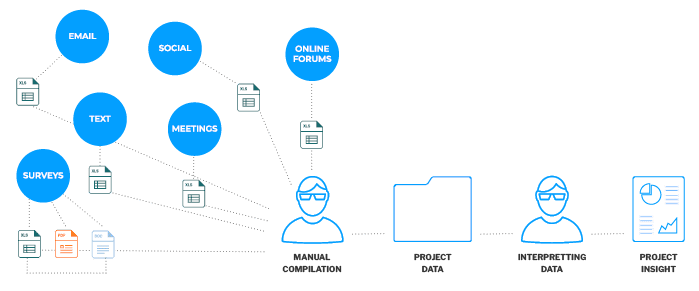
Most agencies aren’t struggling to do engagement, they’re struggling to manage it across too many disconnected tools. They’re holding meetings, launching surveys, sending outreach, and collecting input often across systems that weren’t designed to work together, let alone support compliance.
That fragmentation doesn’t usually feel like a problem during day-to-day operations. The risk surfaces under pressure, and by then the gap between “we ran the process” and “we can prove we ran it fairly” is already open.
And when it is (through an open records request, an accessibility complaint, a project challenge, or an audit) the gap becomes clear. There is a difference between running an engagement process and being able to prove it was conducted fairly, accessibly, and completely.
Disconnected tools don’t just create operational inefficiency. They create compliance exposure, often at exactly the wrong time. Community engagement software built for government is designed to address both together, rather than as separate projects bolted onto separate tools.
What Compliance Risk Means for Public Engagement
Compliance in public engagement isn’t one thing. It spans three distinct areas, each with its own requirements and its own exposure surface.
| Category | What It Requires | Where It Lives |
|---|---|---|
| Open records | A complete, accurate, organized record of what was collected, when, through which channel, and how it was handled | Public records statutes (federal and state) |
| ADA & accessibility | WCAG 2.2-compliant digital tools, captioning for public meetings, and accommodation pathways that don’t require special exceptions | Section 508, Americans with Disabilities Act |
| Inclusion | Meaningful access for limited English proficiency communities, sociodemographic representation, and mitigation of disproportionate impacts on underrepresented populations | Public Participation Plans, LEP Plans, Title VI Plans |
None of these requirements are new. What’s changed is the complexity of the engagement process that has to meet them.
How a Disjointed Approach Creates Compliance Exposure
The operational burden of disconnected tools is well understood. The compliance exposure is less obvious, and more consequential. Three failure patterns show up consistently across local government engagement teams and other agencies running formal public processes.
Open records risk: delays, inefficiency, and loss of trust. When records are spread across systems, even straightforward requests become time-consuming to fulfill. Staff must manually locate, reconcile, and validate information from multiple sources, slowing response times and increasing the likelihood of incomplete production. The risk isn’t just noncompliance. It’s missed deadlines, strained staff capacity, and diminished public trust in the process.
ADA risk: inconsistent accessibility across the engagement process. Accessibility isn’t evaluated tool by tool, it’s evaluated end to end. When survey platforms, meeting tools, and outreach channels don’t align, gaps emerge. A process that appears compliant in parts can fail as a whole, exposing the agency to complaints and requiring reactive remediation under scrutiny.
Inclusion risk: inability to demonstrate equitable outreach. Digital-first engagement alone can’t reach all communities, and language access is only part of the gap. When outreach doesn’t extend across channels, languages, and underrepresented populations, or isn’t documented across them, agencies can’t demonstrate that participation opportunities were equitable. The risk isn’t just who was missed. It’s the absence of a defensible record showing reasonable effort to include them.
The compliance surface isn’t just legal. It’s operational and reputational.
An agency that can’t produce a clean engagement record when asked faces a credibility challenge regardless of what the law requires.
Why the Risk Is Hard to See Until It Surfaces
None of this means agencies are operating recklessly. The risk is structural and largely invisible during normal operations.
Day-to-day engagement work doesn’t stress-test the record. Staff run the process, collect the input, and move to the next project. Whether the record would hold up under formal review rarely comes up until it has to.
Staff turnover accelerates the problem. Institutional knowledge about where records are stored, how input was collected, and which tools were used often lives with individual team members. When those people leave, the continuity of the record goes with them, unless the system was designed to preserve it independently.
The compliance surface has also expanded as engagement has moved to hybrid and digital formats. An in-person public meeting with a sign-in sheet and a recording was a contained process. A hybrid meeting with video participants, phone-in callers, a live chat, and an online input form creates four simultaneous streams of record that have to be reconciled into one coherent whole. The tools most agencies are using weren’t designed for that reconciliation.
What a Compliance-Ready Engagement Process Looks Like
The structural answer is a process where the record is a natural output of doing the work itself, not a layer added after.
A compliance-ready engagement process keeps a unified record. Every comment, survey response, meeting participation, and outreach attempt is captured in a single system, tied to a specific project. The record exists continuously, not assembled after the fact.
Accessibility is built into the workflow, not added as an accommodation. Accessible public meeting management tools, WCAG-compliant input options, and captioning are the default configuration, built in from the start rather than activated on request.
Online and offline resident outreach is captured as part of the record. Every channel used, every population targeted, and every outreach attempt is stored alongside the input it generated. When a Title VI question comes up, the answer is in the system.
Public engagement analytics and reporting turns that record into something defensible: socioeconomic breakdowns, geographic analysis, and participation summaries that show who was reached and how.
Continuity is a system property, not a person property.
The Question to Ask Before Something Goes Wrong
Agencies doing public engagement well are asking a straightforward question before anything goes wrong: if we had to produce the full record of this engagement process tomorrow, could we?If the answer involves locating files across multiple platforms, contacting former staff, or manually reconciling exports from disconnected tools, the risk is already present. See how community engagement software built for government is designed so that question has a clean answer every time.